Home/Blog/LFM3 by Liquid AI: Powering the Next Generation of On-Device Intelligence in AI Offices
human + AI workflows
LFM3 by Liquid AI: Powering the Next Generation of On-Device Intelligence in AI Offices
LFM3 by Liquid AI: Powering the Next Generation of On-Device Intelligence in AI Offices The landscape of artificial intelligence is rapidly evolving, moving beyond cloud-centric pa
9 MIN READ
28 Oct 2026
human + AI workflows
LFM3 by Liquid AI: Powering the Next Generation of On-Device Intelligence in AI Offices
The landscape of artificial intelligence is rapidly evolving, moving beyond cloud-centric paradigms to embrace the power of on-device intelligence. At the forefront of this shift is LFM3 by Liquid AI, a family of Liquid Foundational Models (LFMs) engineered to deliver sophisticated AI capabilities directly to the edge. This innovation is not merely a technical advancement; it represents a strategic leap for organizations envisioning truly integrated AI offices, where human and AI agents collaborate seamlessly within a shared workspace like Nonilion, enhancing productivity and fostering a new era of digital teamwork.
01LFM3 by Liquid AI: Redefining Foundational Models for the Edge
LFM3 by Liquid AI introduces a groundbreaking approach to AI, focusing on efficiency and on-device deployment. Unlike traditional large language models that often demand extensive cloud infrastructure, LFM3 models are designed to run locally, directly on devices such as laptops, Android phones, and even within automotive systems [1, 5, 6]. This fundamental design choice empowers applications that require real-time processing, enhanced data privacy, and robust offline capabilities.
Want your team to run this workflow with AI-native execution?
At its core, LFM3 is part of a lineage of Liquid Foundational Models that are not based on the Transformer architecture, yet achieve state-of-the-art performance across numerous benchmarks [4]. This architectural innovation is key to their efficiency, allowing for powerful AI to operate within the constraints of edge hardware. For instance, the LFM3-VL-2B model is a vision-language model within the LFM3 family specifically crafted for on-device deployment, capable of processing text, images, and videos at their native resolution [6]. This capability is crucial for AI agents operating in dynamic environments, ensuring rapid understanding and response without relying on constant cloud connectivity.
Liquid AI's commitment to on-device performance is evident in prior models like LFM2-VL-3B, which, built on the LFM2-2.6B backbone, targets applications demanding higher accuracy while retaining the speed advantages of the LFM2 architecture [3]. Similarly, LFM2-VL models were introduced as efficient vision-language models for low-latency, device-aware text and image use, extending the LFM2 family into multimodal capabilities [7]. LFM3 builds upon these innovations, pushing the boundaries of what's possible for intelligent systems at the very edge of the network.
02Unleashing Multimodal Capabilities: Vision, Language, and Audio with LFM3
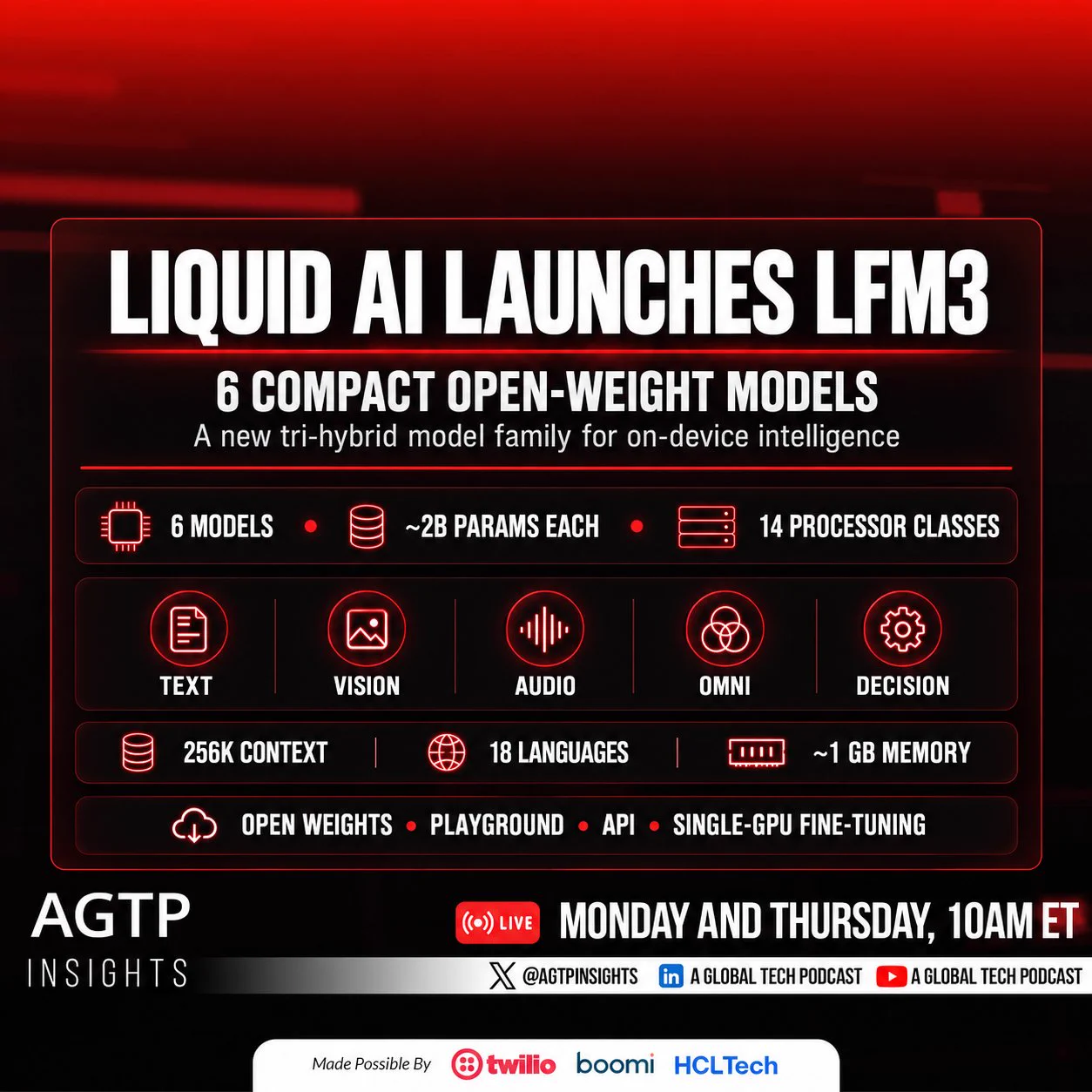
The true power of LFM3 by Liquid AI lies in its comprehensive multimodal capabilities. These models are not limited to processing a single type of data; they seamlessly integrate text, vision, and audio inputs, enabling a holistic understanding of complex environments [1]. This multimodal proficiency is essential for AI agents to interact naturally and effectively with the physical and digital worlds.
Liquid AI unveils six LFM3 models spanning text, vision, audio and decision tasks · Digg · https://digg.com/ai/dphuzlkj
LFM3-VL-2B exemplifies this integration, offering advanced features such as video understanding, sophisticated thinking processes, and spatial and embodied reasoning [6]. These capabilities allow AI agents to not only perceive but also interpret and act upon diverse sensory information. Consider the implications for an AI office: agents could analyze video feeds from collaborative whiteboards, transcribe real-time discussions, and understand visual cues in presentations, all while maintaining context across different modalities.
Liquid AI's Examples Library showcases a wide array of practical applications leveraging these multimodal strengths [1]. For instance, the ability to perform Audio Transcription in Real-Time or English-Korean Translation on a laptop demonstrates immediate utility for global teams [1]. Real-Time Video Captioning and a Vision Language Model Demo highlight how LFM3 can interpret visual information dynamically, which is vital for understanding non-verbal communication or complex diagrams in a virtual meeting [1]. Furthermore, an Audio Car Cockpit Demo illustrates the potential for natural voice interaction and environmental awareness, a concept directly transferable to voice-controlled interfaces within an AI office environment [1]. These examples underscore LFM3's versatility and its capacity to empower AI agents with a comprehensive perception of their operational context.
03Proactive AI Agents: LFM3's Role in Intelligent Meeting Collaboration
The integration of LFM3 by Liquid AI marks a significant step towards truly proactive and intelligent AI agents, particularly in collaborative settings. Imagine a world where AI agents don't just passively observe but actively contribute to discussions and workflows. This vision is becoming a reality, as LFM3 proactive agents are already demonstrating their ability to join meetings, capture conversations, and even draft responses on AMD Ryzen AI PCs [2].
This capability fundamentally transforms how human and AI teams can collaborate. In a dynamic AI office environment, LFM3-powered agents can act as intelligent assistants, ensuring that no critical information is missed. They can automatically generate a Meeting Summarization CLI, distilling lengthy discussions into concise, actionable insights [1]. This not only frees up human participants to focus on strategic contributions but also ensures that decisions and action items are accurately recorded and disseminated, fostering greater accountability and efficiency.
Beyond summarization, LFM3's reasoning capabilities [6] enable agents to perform more complex tasks. Examples like Browser Control with GRPO and AI Agents with Koog [1] illustrate the potential for agents to execute tasks based on meeting outcomes, manage information flows, or even interact with web-based tools on behalf of the team. For Nonilion, this means AI agents could leverage LFM3 for real-time meeting intelligence, enhancing team coordination by providing instant context, automating follow-up tasks, and ensuring that every stakeholder is aligned, ultimately streamlining workflow automation and elevating the human + AI co-working experience.
04The Strategic Imperative of On-Device AI for Future-Proofing AI Offices
For organizations building the AI offices of tomorrow, the strategic imperative is clear: on-device AI, exemplified by LFM3 by Liquid AI, is not just an advantage—it's a necessity. The shift from cloud-dependent models to edge-first solutions addresses critical challenges related to data privacy, latency, and operational resilience. LFM3-VL-2B, specifically designed for on-device deployment [6], embodies this philosophy, bringing powerful AI capabilities directly to where the data is generated and consumed.
This approach is particularly critical in sensitive domains such as the automotive industry, where custom in-car AI assistants must run in real-time on existing CPUs and NPUs, without relying on cloud dependencies [5]. The benefits for an AI office are analogous: local processing ensures that sensitive company data remains within the organizational perimeter, mitigating privacy risks associated with transmitting data to external cloud servers. Furthermore, the elimination of network latency for core AI functions means real-time interactions are genuinely instantaneous, crucial for fluid human-AI collaboration and rapid decision-making.
Liquid AI's models are engineered for efficiency, with examples like LFM2.5-1.2B-Thinking running on under 1GB of memory, CPU-only, achieving 10 to 15 tokens per second with approximately 1.5 seconds of latency [8]. This level of optimization means that advanced AI capabilities can be deployed on standard office hardware, reducing the need for specialized, expensive infrastructure. For a virtual office environment like Nonilion, this translates into a robust, secure, and highly efficient ecosystem where AI agents can operate autonomously and responsively, even in scenarios with intermittent connectivity or stringent data governance requirements. This edge-first strategy future-proofs the AI office, ensuring continuous operation and peak performance regardless of external network conditions, fostering a truly resilient and empowered human + AI workforce.
05Expanding Horizons: Practical Applications and Customization with LFM3
The versatility of LFM3 by Liquid AI extends across a broad spectrum of practical applications, demonstrating its adaptability for diverse enterprise needs and its potential for deep customization. The Examples Library in Liquid Docs provides a compelling glimpse into the myriad ways LFM3 models can be deployed, from everyday productivity tools to highly specialized industry solutions [1]. This breadth of application underscores LFM3's foundational strength and its capacity to be tailored for specific operational contexts within an AI office.
For instance, the Laptop Examples include an Invoice Extractor Tool and a Flight Search Assistant, showcasing how LFM3 can automate routine administrative tasks and provide intelligent assistance for complex queries [1]. These capabilities are directly transferable to an AI office, where agents could streamline financial processes or manage travel logistics with minimal human intervention. Android Examples further highlight on
06Why This Trend Matters for Nonilion
This trend matters to Nonilion because it points to a bigger change: teams are moving from simple calls toward persistent, AI-supported collaboration spaces. Nonilion can bridge live presence, meeting context, avatars, and follow-up work so the trend becomes a usable workflow instead of a headline.
07Shareable Extracts
The trend is not just "LFM3 by Liquid AI: Powering the Next Generation of On-Device Intelligence in AI Offices" - it is a signal that team coordination is becoming the next competitive edge.
Hot take: the teams that win from this shift will not be the ones with more meetings; they will be the ones with clearer shared context after every meeting.
If lfm3 by liquid ai: powering the next generation of on-device intelligence in ai offices keeps moving this fast, remote teams need a workspace where conversation, presence, and follow-up stay connected.
LFM3 by Liquid AI: Powering the Next Generation of On-Device Intelligence in AI Offices The landscape of artificial intelligence is rapidly evolving, moving beyond cloud-centric paradigms to embrace the power of on-device intelligence.
At the forefront of this shift is LFM3 by Liquid AI, a family of Liquid Foundational Models (LFMs) engineered to deliver sophisticated AI capabilities directly to the edge.
08Social Hooks
Everyone is talking about LFM3 by Liquid AI: Powering the Next Generation of On-Device Intelligence in AI Offices. The overlooked part is what happens to team workflows after the headline fades.
The uncomfortable question behind LFM3 by Liquid AI: Powering the Next Generation of On-Device Intelligence in AI Offices: are teams adapting their collaboration systems fast enough?
This is not a meeting trend. It is a coordination trend, and products like Nonilion sit right in the middle of that shift.