Home/Blog/Fixing Tool-Call Accuracy in vLLM: Architecting Reliable AI Agent Workloads
human + AI workflows
Fixing Tool-Call Accuracy in vLLM: Architecting Reliable AI Agent Workloads
Fixing Tool-Call Accuracy in vLLM: Architecting Reliable AI Agent Workloads Agentic AI is rapidly transforming how we interact with large language models (LLMs), moving beyond simp
14 MIN READ
26 Oct 2026
human + AI workflows
Fixing Tool-Call Accuracy in vLLM: Architecting Reliable AI Agent Workloads
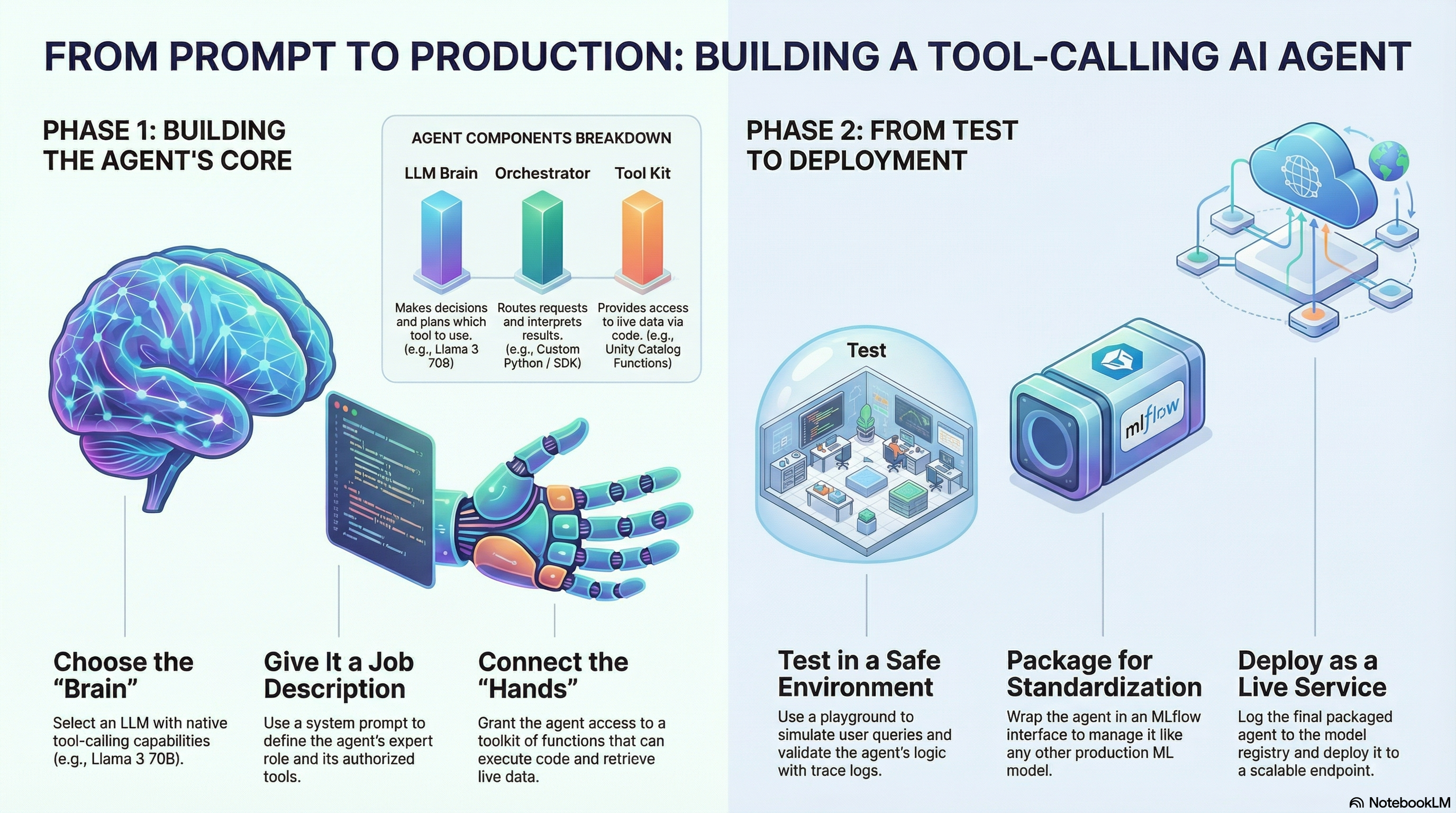
Agentic AI is rapidly transforming how we interact with large language models (LLMs), moving beyond simple conversational interfaces to systems capable of complex, multi-step tasks. At the core of this revolution lies robust tool-calling—the ability for an LLM to reliably invoke external functions, databases, or APIs. However, for open-weight models served on high-performance inference engines like vLLM, ensuring precise and consistent tool-call accuracy has presented significant challenges, often leading to performance far below quality benchmarks. This foundational accuracy is paramount for AI agents to function dependably, especially in collaborative AI office environments like Nonilion, where human and AI agents co-exist to drive productivity and innovation.
01The Unseen Foundation: Understanding Tool-Call Schemas and Their Importance
Tool-call schemas are the unseen blueprints that guide an AI model's interaction with the external world. To enable an LLM to call an external tool, a two-step process is typically followed: first, the AI model is informed about the existence of available tool calls, and second, it's provided with instructions on how to output structured tool-calls (Source 1). For instance, when connecting an application like OpenCode to a model like Kimi, OpenCode sends Kimi a JSON array describing the available tools, such as a webfetch tool designed to retrieve web page contents (Source 1).
Want your team to run this workflow with AI-native execution?
The importance of schema accuracy cannot be overstated, particularly in serving agentic workloads. Tool-calling accuracy testing measures how reliably a large language model decides which function to call, fills in correct arguments, and emits a payload that conforms to the tool's JSON schema (Source 7). When tool calls are inaccurate, the model begins to build upon nonsensical context, inevitably leading to low-quality results (Source 1). This degradation is particularly pronounced in agentic workflows where multi-turn sessions are common, as errors can accumulate over time (Source 1, Source 4). In a collaborative AI office, where AI agents might be responsible for critical tasks like meeting follow-ups or workflow automation, schema adherence is not just a technical detail—it's a prerequisite for trustworthy and effective human + AI collaboration.
02Diagnosing Common Tool-Calling Challenges in vLLM
Despite the theoretical capabilities of many open-weight models, their practical performance on widely-used inference engines often falls short of expectations when it comes to tool-call accuracy. This discrepancy highlights the critical need for careful debugging and optimization.
One prominent example involved the Kimi K2 model on vLLM. When Kimi K2.6 was served with vLLM version 0.28, the expected tool call schema was generated only 92% of the time, meaning 2 out of every 25 attempted tool calls failed (Source 1). This issue was not isolated. Further investigation into Kimi K2's tool-calling on vLLM revealed a success rate below 20% in some instances, with only 218 out of over 1200 potential tool calls successfully parsed (Source 2). The debugging journey uncovered three core issues:
Missing add_generation_prompt: A critical component for guiding the model's output (Source 2).
Empty content Derailed Prompt: Prompts with empty content fields could disrupt the model's reasoning (Source 2).
Overly Strict Tool-Call ID Parser: The parser was too rigid, leading to valid tool calls being rejected (Source 2).
Similarly, critical bugs were identified in the kimi_k2_tool_parser.py when parsing tool calls generated by Kimi-K2.5 within thinking/reasoning sections, causing schema accuracy to drop to approximately 87% (Source 3). These issues were compounded by an 8KB buffer limit that blocked large outputs and memory problems with unbounded buffers (Source 3).
The challenges extend beyond Kimi models. Users have reported
reports of tool-call failures with other model families when the chat template, parser, and API request are not aligned. A model may be capable of producing valid JSON in a raw completion test, yet fail when it receives a differently formatted prompt through an OpenAI-compatible endpoint. This is why tool calling must be treated as an end-to-end contract rather than a model-only feature.
03Aligning the Model, Chat Template, and Parser
The first step in improving accuracy is to verify that every layer agrees on the same tool-call format. A typical request passes through several transformations:
The client converts tool definitions into an API request.
vLLM applies the model’s chat template.
The model generates text, potentially including reasoning and a tool call.
vLLM’s tool parser extracts the call.
The client validates the name and arguments against the original schema.
A defect in any one of these stages can appear as a model failure. For example, a template may place tool definitions in a format the model was never trained to recognize. Alternatively, the model may generate a valid call wrapped in a reasoning block that the parser does not inspect. The result is the same from the application’s perspective: no usable tool call is returned.
Inspect the Rendered Prompt
Before changing sampling parameters or retraining a model, capture the exact prompt sent to the model. Do not inspect only the high-level messages supplied by the application. The important details are introduced during template rendering, including:
The location and wording of tool definitions
Whether a system message is present
Whether the assistant turn ends with a generation marker
Whether the request explicitly permits tool calls
How previous tool results are represented
Whether empty message content is preserved
How reasoning and tool-call sections are delimited
The add_generation_prompt setting is especially important. In many chat templates, this option appends the tokens that signal the beginning of a new assistant response. Without them, the model may interpret the request as complete, continue a previous turn, or produce ordinary prose instead of a structured call.
A useful debugging procedure is to render the same conversation in two ways: once through the production client and once with the tokenizer’s chat-template utility. Compare the resulting token sequence or text representation. Differences often reveal that the application is omitting a generation prompt or passing fields in an unexpected order.
Handle Empty Content Explicitly
OpenAI-compatible messages can contain optional or empty content fields, particularly when an assistant message consists only of a tool call. Some templates assume that every message has textual content and insert an empty string into a position where the model expects a meaningful marker. This can shift delimiters or produce a malformed conversational sequence.
Applications should normalize messages before sending them. A normalization layer can distinguish among:
A textual assistant response
An assistant message containing a tool call
A tool result
A reasoning segment
A genuinely empty message
The goal is not to invent content, but to ensure that each message is represented in the format expected by the selected template. If a model’s documented template requires a particular assistant or tool marker, use that marker consistently rather than relying on generic defaults.
04Choosing and Configuring the Correct Tool Parser
vLLM uses model-appropriate parsers to turn generated text into structured tool calls. Parser selection should therefore be explicit when the model requires a specialized format. A generic parser may expect a pattern such as a conventional JSON block, while a model may use custom tags, a function-call envelope, or a reasoning-aware representation.
A parser must answer several questions reliably:
Where does the tool call begin?
Where does it end?
Which text belongs to the function name?
How are arguments escaped?
Can multiple calls appear in one response?
Can a call occur after a thinking section?
How should incomplete streaming fragments be handled?
What happens when an identifier contains an unfamiliar but valid character?
Overly strict parsing is a common source of false negatives. If a parser validates identifiers with a narrower pattern than the API contract requires, a call can be rejected even though its function name and arguments are valid. Parsers should enforce the actual schema requirements, not assumptions inherited from one sample output.
When modifying a parser, preserve compatibility with both streamed and non-streamed responses. A parser that works on a complete string may fail when the same output arrives in chunks. Delimiters can be split across chunks, and JSON escape sequences can arrive one character at a time. Stateful buffering is required: the parser should retain enough context to recognize a token boundary without retaining unbounded output indefinitely.
05Streaming, Buffering, and Reasoning Sections
Streaming introduces a second class of reliability problems. Tool-call extraction cannot assume that a complete JSON object is available in each event. Instead, the server may emit a function name in one chunk, an opening brace in another, and the remaining arguments over many subsequent chunks.
A robust implementation should:
Maintain a bounded buffer for the current candidate call.
Track whether the parser is inside a string.
Track escaped quotation marks and backslashes.
Track nested braces and brackets.
Distinguish JSON punctuation from the same characters inside strings.
Emit the call only after the object is complete and validated.
Return a clear error when the buffer limit is exceeded.
Buffer limits should be selected based on realistic argument sizes rather than an arbitrary small threshold. At the same time, limits are necessary to prevent malformed generations from consuming memory indefinitely. Large tool arguments—such as SQL statements, document excerpts, or arrays of records—should generally be passed by reference through a file, object store, or application identifier instead of embedded directly in a call.
Reasoning-capable models add another complication. The model may generate internal reasoning before presenting a tool call, and the reasoning may use syntax resembling JSON or function tags. The parser must know which sections are actionable and which are metadata. If it scans the entire response indiscriminately, it may mistake an example in the reasoning text for the actual call. Conversely, if it looks only at the final text segment, it may miss a valid call emitted inside a model-specific structured field.
The safest approach is to use the model’s supported reasoning and tool-call format rather than attempting to infer boundaries with regular expressions alone.
Prompt instructions are useful, but they do not guarantee valid output. Where supported, constrained decoding can reduce syntax errors by restricting generation to tokens compatible with a JSON schema or grammar. This is particularly helpful for arguments with fixed types, enumerated values, and required fields.
Constrained decoding should not be treated as a replacement for parser validation. It may ensure that an object is syntactically valid while still allowing an incorrect function name, an unsuitable value, or a missing business rule. Validation should occur in layers:
Syntax validation: Is the output valid JSON?
Schema validation: Do the fields, types, and required properties match?
Semantic validation: Are the values meaningful and safe?
Authorization validation: Is this agent allowed to perform the requested action?
For example, a calendar tool may receive valid JSON containing a date in the past. A database tool may receive a syntactically valid query that attempts an unauthorized table operation. These are application-level failures and must be rejected before execution.
A practical system returns structured validation errors to the model when recovery is safe. Instead of silently executing a malformed request, the orchestrator can ask the model to correct the arguments. Retry limits should be finite, and high-impact operations should require human confirmation or a separate policy check.
07Building a Repeatable Evaluation Harness
Tool-call accuracy should be measured with a test set that reflects production behavior. A small collection of manually selected examples is insufficient because failures often depend on message history, tool ordering, argument size, and streaming boundaries.
An evaluation harness should include:
Single-tool and multi-tool requests
Similar tool names that test selection accuracy
Required and optional arguments
Nested objects and arrays
Unicode, quotation marks, and escaped characters
Empty and null values
Long argument strings
Multi-turn conversations with tool results
Reasoning-enabled responses
Streaming and non-streaming requests
Requests where no tool should be called
Track more than a single pass rate. Useful metrics include tool-selection accuracy, argument exact-match rate, schema-validation rate, parser recovery rate, latency to the first tool-call token, and the percentage of responses requiring retries. Categorize failures by layer—template, generation, parsing, validation, or orchestration—so improvements can be targeted.
Every discovered bug should become a regression test. For example, once an empty-content message causes a failure, add that exact conversation to the suite and run it against every future vLLM, model, template, and parser change.
08A Production Reliability Checklist
Before deploying an agent workload, teams should verify that:
The model’s recommended chat template is being used.
add_generation_prompt behavior has been tested explicitly.
Tool definitions match the model’s expected representation.
The selected vLLM parser supports the model’s output format.
Reasoning sections and tool-call sections are unambiguously separated.
Streaming has been tested with chunk boundaries at arbitrary positions.
Parser buffers are bounded but large enough for expected arguments.
Tool names and arguments are validated independently of parsing.
Retries have limits and do not repeat dangerous side effects.
Tool execution is authorized outside the model.
Logs capture the rendered request, parser state, validation result, and request identifiers without exposing secrets.
A regression suite runs whenever the model, vLLM version, tokenizer, or template changes.
09Conclusion
Reliable tool calling in vLLM depends on coordination across the entire inference stack. Model capability matters, but it is only one part of the system. Chat-template markers, empty-message handling, parser selection, streaming buffers, reasoning boundaries, constrained decoding, and application validation all influence whether a generated call becomes an executable action.
The most effective debugging strategy is therefore systematic: capture the rendered prompt, reproduce the failure with a minimal request, identify the layer that breaks the contract, and convert the fix into a permanent regression test. With that discipline, teams can move from fragile demonstrations to dependable agent workloads—an essential foundation for collaborative AI environments where human and AI agents must operate accurately, transparently, and safely.
For Fixing Tool-Call Accuracy in vLLM, Nonilion can be used as the practical AI-office example: a shared workspace where human teammates and AI agents keep discussion, decisions, and execution connected.
10Why This Trend Matters for Nonilion
This trend matters to Nonilion because it points to a bigger change: teams are moving from simple calls toward persistent, AI-supported collaboration spaces. Nonilion can bridge live presence, meeting context, avatars, and follow-up work so the trend becomes a usable workflow instead of a headline.
11Shareable Extracts
The trend is not just "Fixing Tool-Call Accuracy in vLLM: Architecting Reliable AI Agent Workloads" - it is a signal that team coordination is becoming the next competitive edge.
Hot take: the teams that win from this shift will not be the ones with more meetings; they will be the ones with clearer shared context after every meeting.
If fixing tool-call accuracy in vllm: architecting reliable ai agent workloads keeps moving this fast, remote teams need a workspace where conversation, presence, and follow-up stay connected.
At the core of this revolution lies robust tool-calling—the ability for an LLM to reliably invoke external functions, databases, or APIs.
However, for open-weight models served on high-performance inference engines like vLLM, ensuring precise and consistent tool-call accuracy has presented significant challenges, often leading to performance far below quality benchmarks.
12Social Hooks
Everyone is talking about Fixing Tool-Call Accuracy in vLLM: Architecting Reliable AI Agent Workloads. The overlooked part is what happens to team workflows after the headline fades.
The uncomfortable question behind Fixing Tool-Call Accuracy in vLLM: Architecting Reliable AI Agent Workloads: are teams adapting their collaboration systems fast enough?
This is not a meeting trend. It is a coordination trend, and products like Nonilion sit right in the middle of that shift.