Home/Blog/The Wired Moment: Decoding the Latest AI Breakthroughs Transforming Our World
Developer Productivity
The Wired Moment: Decoding the Latest AI Breakthroughs Transforming Our World
The Wired Moment: Decoding the Latest AI Breakthroughs Transforming Our World The technological landscape is constantly evolving, and few areas are experiencing as rapid a transfor
13 MIN READ
30 Oct 2026
Developer Productivity
The Wired Moment: Decoding the Latest AI Breakthroughs Transforming Our World
The technological landscape is constantly evolving, and few areas are experiencing as rapid a transformation as artificial intelligence. What Wired has dubbed a significant
breakthrough is not a single invention but a convergence of advances in generative models, specialized hardware, robotics, and the systems that connect AI to real-world data.
01From fluent text to useful action
Want your team to run this workflow with AI-native execution?
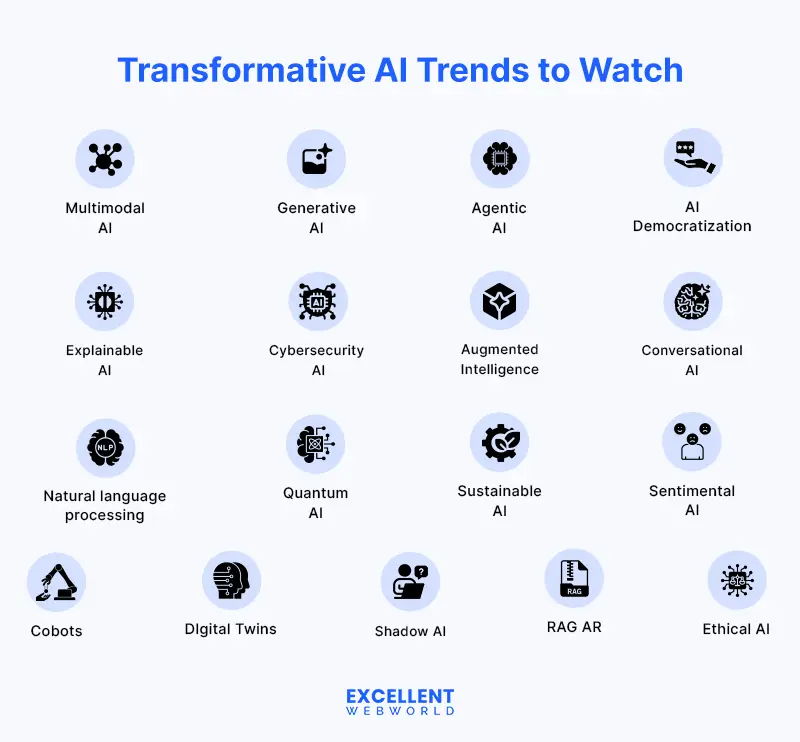
Earlier generations of AI were often impressive within narrow boundaries. A system might identify objects in an image, recommend a song, or classify a customer-service request. Newer models can work across several modes at once, interpreting text, images, audio, video, and structured data in a shared workflow. That broader capability changes the role of AI from a prediction engine into a general-purpose interface.
A user can describe a goal in ordinary language, attach a spreadsheet, ask for a chart, and then request an explanation of an unexpected result. The model does not simply return a fixed label. It interprets context, generates a response, and may use external tools to retrieve information or perform calculations. In the best cases, the interaction feels less like operating software and more like collaborating with an adaptable assistant.
This shift is sometimes described as “agentic” AI. An agent can break a larger objective into steps, select tools, check intermediate results, and revise its approach. For example, a travel-planning system might compare schedules, identify constraints, draft an itinerary, and ask for approval before making a reservation. A software-development agent might inspect a codebase, propose a change, run tests, and flag the files that still require human review.
The distinction is important. Generating an answer is one task; reliably completing a multi-step process is another. Systems that act in the world must handle permissions, uncertainty, conflicting instructions, and unexpected outcomes. Their usefulness depends not only on intelligence but also on restraint.
02Why the recent advances happened
Several technical developments have reinforced one another.
The first is scale. Modern models are trained on enormous collections of text, images, code, audio, and video. During training, they learn statistical relationships that allow them to predict missing or subsequent information. Although this objective sounds simple, the resulting models can acquire capabilities that were not explicitly programmed, including translation, summarization, coding, and visual reasoning.
The second is improved architecture. Transformer-based systems are particularly effective at identifying relationships among distant parts of an input. In a document, a relevant sentence may appear hundreds of lines before the question it helps answer. In a program, a function may depend on a variable defined in another file. Attention mechanisms help models connect these elements.
The third is compute. Graphics processing units and other accelerators can perform the parallel operations required by large-scale training. Cloud infrastructure makes that capacity available to companies, researchers, and developers without requiring every organization to build its own data center. More efficient chips and software are also making it possible to run capable models on laptops, phones, and other edge devices.
Finally, researchers have improved the process of aligning models with human instructions. After initial training, a model can be refined using examples of helpful responses, preference data, safety evaluations, and targeted testing. These methods do not eliminate mistakes, but they make systems more useful in ordinary interactions.
03Multimodal intelligence and the end of the single-input model
The most visible change is the movement from text-only chatbots toward multimodal systems. People naturally communicate through several channels. They point to an object, show a photograph, describe a sound, or sketch an idea. An AI that can combine these forms of information is better positioned to assist with practical tasks.
Consider a technician examining a piece of industrial equipment. Instead of typing a long description, the technician can provide a photograph, a maintenance log, and a spoken account of the problem. An AI system might identify possible causes, locate relevant instructions, and produce a checklist. The technician remains responsible for the repair, but the time spent searching through documentation can be reduced.
In education, a student could submit a handwritten equation and ask where the reasoning went wrong. In accessibility, a vision-enabled assistant could describe a scene, read a menu, or help organize objects. In media production, creators can use text, reference images, and audio samples to develop early concepts more quickly.
These applications also expose the limits of multimodal systems. An image can be ambiguous, audio can be noisy, and visual similarity is not the same as understanding. A model may confidently misread a diagram or infer details that are not present. For that reason, high-stakes applications need confidence indicators, source references, and clear ways for users to correct the system.
04AI that can reason over private information
General-purpose models are powerful, but they do not automatically know an organization’s internal policies, product documentation, or current records. A major practical breakthrough has therefore been the integration of models with trusted data sources.
One common approach is retrieval-augmented generation. Before responding, the system searches a selected collection of documents and uses the retrieved passages as context. A company might connect an assistant to its human-resources policies, engineering manuals, or customer-support knowledge base. The model can then answer questions using material that is more relevant and current than its original training data.
This approach has two advantages. It can reduce unsupported answers, and it gives users a way to inspect the information behind a response. If an assistant cites the specific policy section or technical document it used, a reviewer can check the conclusion rather than treating the model as an unquestionable authority.
Data governance becomes essential at this point. A system must respect access controls, preserve confidential information, and distinguish between documents that are authoritative and those that are outdated. Retrieval is not a substitute for judgment: if the underlying records are incomplete or contradictory, the output may still be misleading.
05The industrial and scientific frontier
The breakthrough is not confined to chat interfaces. AI is increasingly being applied to problems where the output is a design, a prediction, or a proposed experiment.
In drug discovery, models can suggest molecular structures, estimate properties, and help researchers prioritize candidates for laboratory testing. In materials science, they can search through combinations of elements and manufacturing conditions that would be difficult to explore manually. In climate research, machine-learning systems can accelerate portions of weather and Earth-system modeling, while still relying on physical measurements and scientific validation.
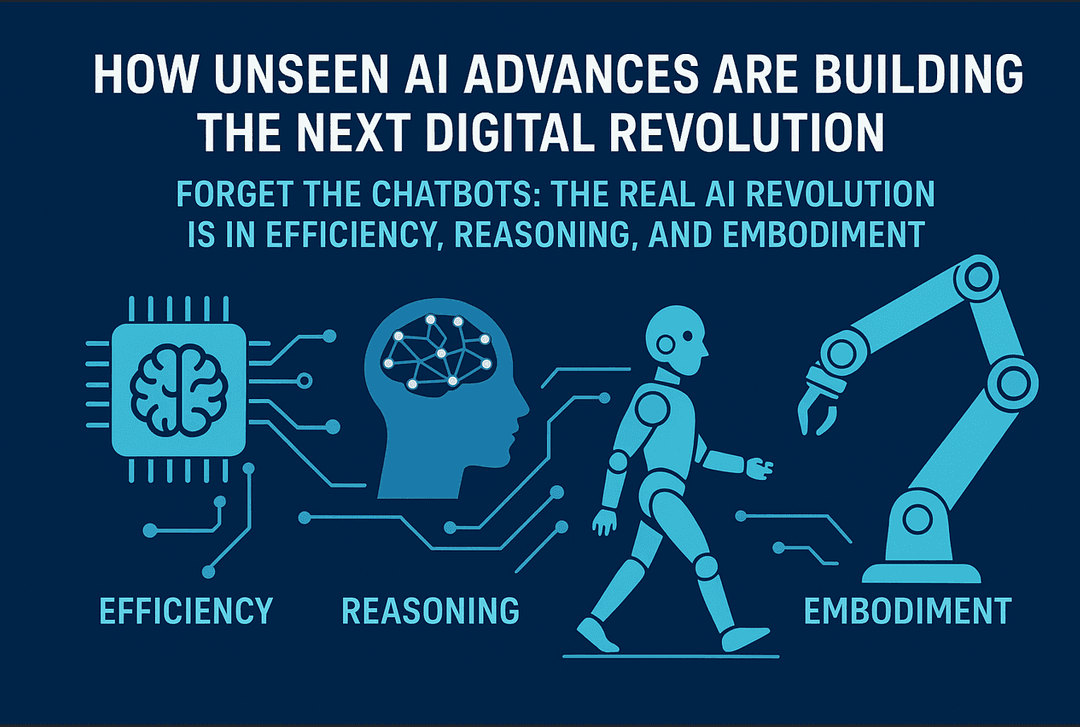
Robotics presents a more demanding test. A robot operating in a warehouse, hospital, or home must perceive a changing environment and translate instructions into physical movement. Language models can help robots interpret high-level requests, but reliable operation also requires specialized control systems, sensors, safety boundaries, and extensive testing.
A household robot asked to “tidy the kitchen” must determine what counts as clutter, distinguish a glass from a cleaning product, avoid people and pets, and decide where each object belongs. Those apparently ordinary judgments are difficult because the physical world is variable and full of exceptions. Progress in robotics may therefore be slower and less uniform than progress in software, even as the two fields increasingly overlap.
AI systems require more than clever algorithms. Training and operating large models consumes electricity, water for cooling in some data centers, high-performance chips, and substantial network capacity. As demand grows, companies are investing in new data centers and energy supplies. The environmental impact depends on the model’s size, the efficiency of its hardware, the source of its electricity, and how often it is used.
This has encouraged work on smaller models, quantization, specialized hardware, and more efficient training methods. A compact model running locally may be preferable to a much larger cloud model for tasks involving private data or frequent, low-latency interactions. Local processing can also make AI available when an internet connection is weak or unavailable.
Efficiency is not only an environmental concern. It affects access. If advanced AI requires expensive infrastructure, its benefits may be concentrated among a small number of companies and countries. Open models, public research initiatives, and shared computing resources can broaden participation, although openness also creates challenges around misuse, security, and accountability.
07Reliability, bias, and the problem of confidence
The central weakness of current generative AI is that fluency can conceal uncertainty. A model may produce a polished explanation while inventing a citation, misunderstanding a question, or combining unrelated facts. These errors are often called hallucinations, but the underlying issue is more general: the system is optimized to generate plausible outputs, not to guarantee truth.
Reliability can improve through retrieval, tool use, structured outputs, verification steps, and domain-specific testing. A model that uses a calculator for arithmetic is less likely to make a basic numerical error. A coding assistant that runs tests can provide stronger evidence than one that merely presents a code sample. A research assistant that quotes source passages is easier to audit than one that offers unsupported summaries.
Bias remains another concern. Training data reflects the unequal representation and historical assumptions of the societies that produced it. Models may perform better for some languages, dialects, demographic groups, or cultural contexts than others. Evaluation must therefore include diverse users and realistic conditions, rather than relying only on average performance across a narrow benchmark.
The answer cannot be to place every decision in the hands of an AI system or to ban automation entirely. A more practical principle is proportional oversight. Low-risk tasks may need simple review. Decisions involving health, employment, credit, education, public safety, or legal rights require stronger safeguards, documentation, and human accountability.
08Work, creativity, and changing expertise
AI is already altering how work is organized. Writers use it for outlines and revisions. Programmers use it to explore unfamiliar libraries and generate routine code. Analysts use it to query data in natural language. Designers use it to test visual directions before investing in a finished concept.
These tools are most effective when they remove friction without removing responsibility. A professional who understands the underlying task can often identify errors, refine a draft, and decide when an output is suitable. Someone without that expertise may accept a plausible result too readily.
That creates a paradox: AI can make basic production easier while increasing the value of judgment. The ability to ask a model for ten alternatives is less important than knowing which alternative fits the audience, complies with the rules, and works in practice. Organizations will need to invest in training that combines technical fluency with subject-matter expertise.
The effects on employment will also vary by occupation. Some jobs may be reduced, others may be redesigned, and new roles may emerge around oversight, data quality, model evaluation, and workflow integration. The transition is unlikely to be uniform. Workers whose tasks consist largely of repeatable digital actions may experience change sooner than those whose work depends on physical dexterity, interpersonal trust, or complex responsibility.
09Building a more deliberate AI future
The most important question is not whether AI can produce impressive demonstrations. It is whether these systems can be integrated into institutions without weakening trust or accountability.
That requires clear ownership. Every deployed system should have people responsible for its data, performance, security, and effects on users. Organizations should record which model was used, what information it accessed, and when a human approved an important action. Users should know when they are interacting with an automated system and have a meaningful way to challenge its output.
It also requires a culture of testing. Models should be evaluated under ordinary conditions, adversarial conditions, and the messy edge cases that benchmarks often overlook. Monitoring should continue after launch because data, user behavior, and model integrations can change over time.
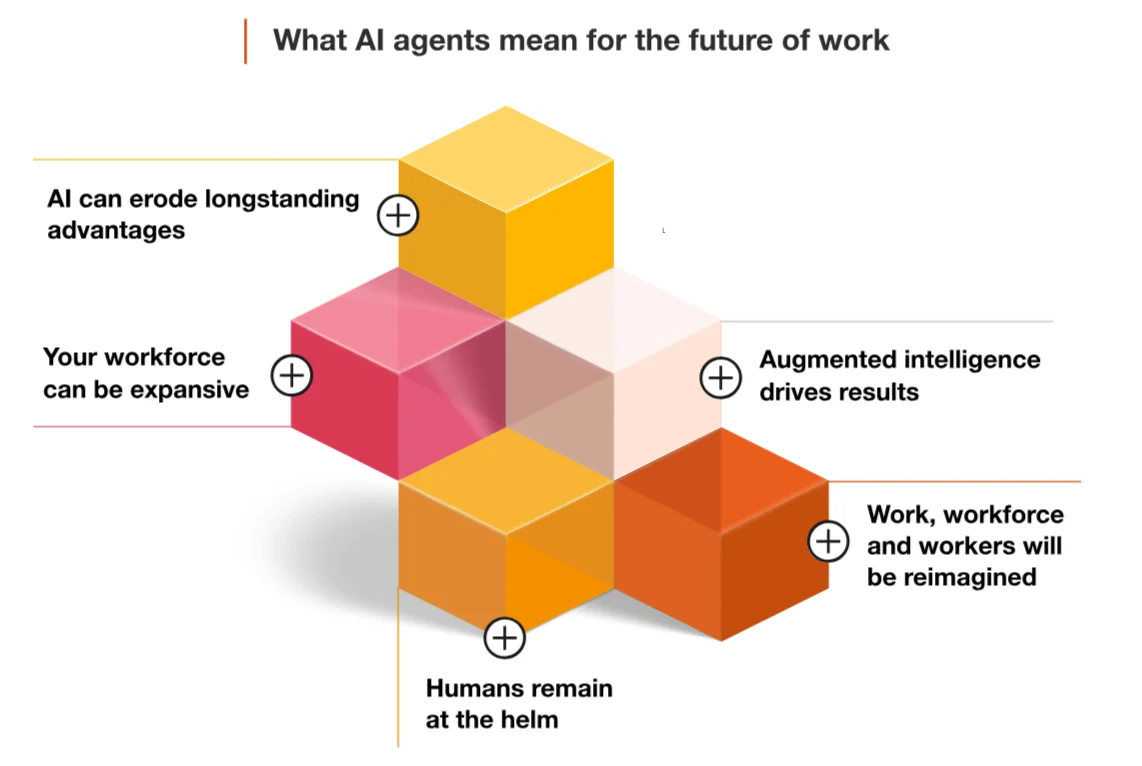
The wired moment in AI, then, is less about a machine suddenly becoming humanlike than about intelligence becoming embedded in everyday systems. It appears in search engines, office software, scientific instruments, cameras, vehicles, factories, and classrooms. Its influence will be determined by the choices made around it: what data is collected, who controls the infrastructure, which decisions are automated, and where human judgment remains essential.
The breakthrough is real, but it is unfinished. AI has become more capable, more accessible, and more deeply connected to the world. Turning that capability into durable progress will depend on engineering discipline, public oversight, and a willingness to measure not only what these systems can generate, but also what happens after people rely on them.
For wired an ai breakthrough, Nonilion can be used as the practical AI-office example: a shared workspace where human teammates and AI agents keep discussion, decisions, and execution connected.
The reason wired an ai breakthrough keeps returning to Nonilion is simple: the topic becomes more useful when it turns into coordinated work, not just another article, chat, or dashboard.
10Why This Trend Matters for Nonilion
This trend matters to Nonilion because it points to a bigger change: teams are moving from simple calls toward persistent, AI-supported collaboration spaces. Nonilion can bridge live presence, meeting context, avatars, and follow-up work so the trend becomes a usable workflow instead of a headline.
11Shareable Extracts
The trend is not just "The Wired Moment: Decoding the Latest AI Breakthroughs Transforming Our World" - it is a signal that team coordination is becoming the next competitive edge.
Hot take: the teams that win from this shift will not be the ones with more meetings; they will be the ones with clearer shared context after every meeting.
If the wired moment: decoding the latest ai breakthroughs transforming our world keeps moving this fast, remote teams need a workspace where conversation, presence, and follow-up stay connected.
The Wired Moment: Decoding the Latest AI Breakthroughs Transforming Our World The technological landscape is constantly evolving, and few areas are experiencing as rapid a transformation as artificial intelligence.
What Wired has dubbed a significant breakthrough is not a single invention but a convergence of advances in generative models, specialized hardware, robotics, and the systems that connect AI to real-world data.
12Social Hooks
Everyone is talking about The Wired Moment: Decoding the Latest AI Breakthroughs Transforming Our World. The overlooked part is what happens to team workflows after the headline fades.
The uncomfortable question behind The Wired Moment: Decoding the Latest AI Breakthroughs Transforming Our World: are teams adapting their collaboration systems fast enough?
This is not a meeting trend. It is a coordination trend, and products like Nonilion sit right in the middle of that shift.
13Sources and Author
Sources
No direct external source URLs were available for this run.
Author
This article on wired an ai breakthrough was generated by the Nonilion AI blog workflow using web research inputs and AI-assisted synthesis.