Home/Blog/The Dawn of Intelligent Orchestration: Understanding GitHub Copilot Fusion
Developer Productivity
The Dawn of Intelligent Orchestration: Understanding GitHub Copilot Fusion
The Dawn of Intelligent Orchestration: Understanding GitHub Copilot Fusion The landscape of software development is in constant flux, driven by relentless innovation and the impera
13 MIN READ
31 Oct 2026
Developer Productivity
The Dawn of Intelligent Orchestration: Understanding GitHub Copilot Fusion
The landscape of software development is in constant flux, driven by relentless innovation and the imperative to deliver high-quality code at unprecedented speeds. In this evolving environment, tools that amplify human potential and streamline complex workflows become indispensable. GitHub Copilot, initially a groundbreaking AI-assisted software development tool, has continued its evolution, leading to the emergence of advanced capabilities like GitHub Copilot Fusion. This strategic advancement signals a shift towards intelligent orchestration in development, promising to redefine how teams interact with AI agents and collaborate on projects. From the perspective of an AI office like Nonilion, where human and AI agents co-exist in a shared virtual workspace, understanding these advancements is crucial for fostering truly synergistic collaboration.
01
Beyond Autocomplete: What is GitHub Copilot Fusion?
GitHub Copilot first launched its preview in 2021 for VSCode users, based on OpenAI technology, quickly becoming one of the first widely adopted AI-assisted software development tools. It significantly increased developer productivity and accelerated software development by providing code suggestions and automating repetitive tasks. The initial promise was to free developers from mundane coding, allowing them to focus on more creative problem-solving.
Want your team to run this workflow with AI-native execution?
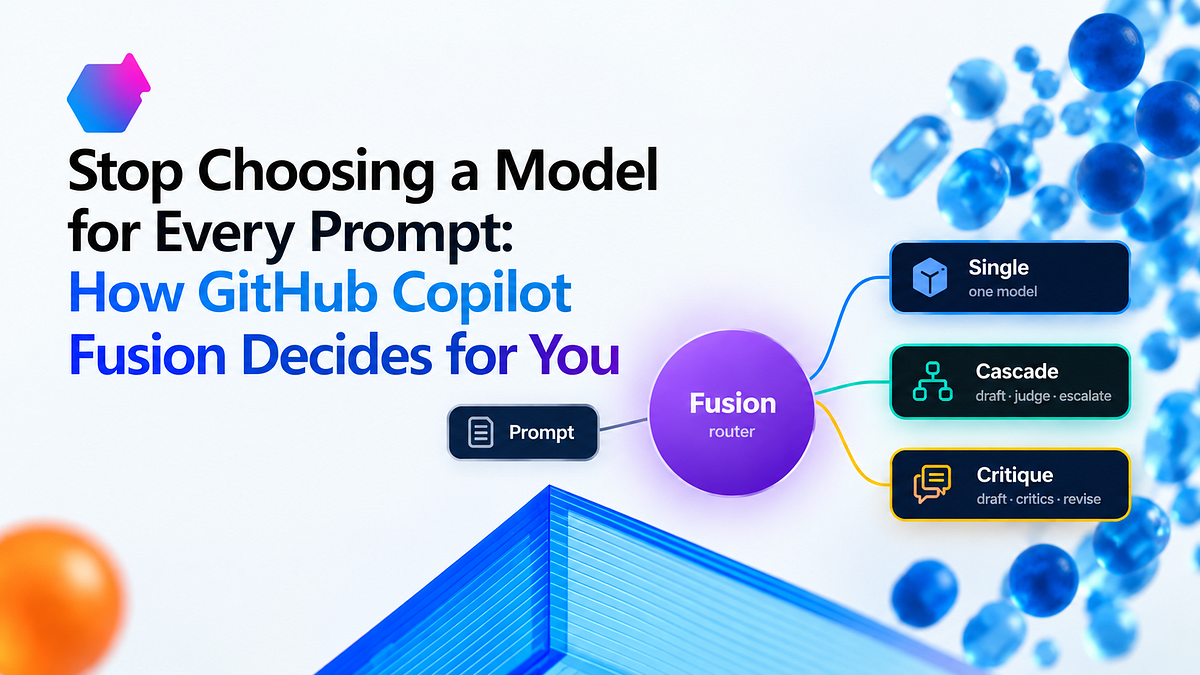
GitHub Copilot Fusion represents the next frontier in this evolution. It is described as
a unified approach to coordinating AI capabilities across the software development lifecycle. Rather than treating AI as a single-purpose assistant embedded in an editor, Fusion can be understood as an orchestration model: multiple specialized agents, tools, repositories, and human contributors working together under shared goals, context, and governance.
This distinction matters. Writing a function is only one part of delivering software. Developers also need to understand requirements, inspect existing systems, design interfaces, create tests, review changes, manage dependencies, document decisions, and monitor production behavior. An intelligent orchestration layer connects these activities so that progress in one stage informs the next.
02From Individual Assistant to Collaborative System
Traditional Copilot interactions are often direct and conversational. A developer asks for a function, explains an error, or requests a test, and the assistant responds. This remains valuable, but larger engineering tasks require more than isolated answers.
Consider a request such as:
Add passwordless authentication, update the user model, expose the necessary API endpoints, write tests, and document the deployment requirements.
Completing this work may involve several distinct responsibilities:
Clarifying ambiguous product requirements
Inspecting the existing authentication architecture
Identifying database and schema changes
Designing secure API behavior
Implementing frontend and backend changes
Writing unit, integration, and end-to-end tests
Reviewing security implications
Updating documentation and deployment configuration
A Fusion-style workflow coordinates these responsibilities instead of leaving the developer to manually divide the task among separate prompts. One agent might analyze the repository, another might propose an implementation plan, and others might focus on testing, security, or documentation. The human developer remains responsible for direction and approval, while the system helps organize the work.
This is not simply a matter of adding more agents. More agents can create more confusion if they do not share context or follow clear boundaries. Effective orchestration depends on assigning roles, maintaining a reliable source of truth, and ensuring that outputs are checked before they influence subsequent tasks.
03The Core Components of Intelligent Orchestration
Although implementations may differ, a coordinated Copilot environment generally depends on several foundational components.
Shared Context
AI agents need access to relevant project information, including source code, issue discussions, pull requests, coding standards, architecture records, and test results. Without this context, an agent may produce technically valid code that conflicts with the project’s conventions or business requirements.
Shared context should be selective rather than unlimited. Supplying every available file and conversation can increase noise, cost, and the likelihood of irrelevant suggestions. A better system retrieves the information most closely related to the current task and makes the origin of that information visible.
For example, an agent proposing a database migration should be able to reference:
The current schema
Existing migration conventions
Data retention requirements
Related models and services
Recent changes affecting the same tables
This allows the agent to reason from the project’s actual state rather than from generic assumptions.
Specialized Agents
A general-purpose coding assistant is useful, but specialized agents can provide more focused analysis. Potential roles include:
Planning agent: Converts a broad requirement into discrete implementation steps.
Repository analyst: Maps dependencies, conventions, and affected components.
Coding agent: Produces or modifies code within an approved scope.
Testing agent: Identifies missing coverage and generates relevant tests.
Security agent: Reviews authentication, authorization, secrets, and unsafe data handling.
Documentation agent: Updates guides, API references, and operational runbooks.
Review agent: Examines proposed changes for correctness, maintainability, and consistency.
These roles do not have to represent independent autonomous systems. They may be different prompts, tools, or modes operating within one platform. The important principle is specialization combined with coordination.
Tool Access
An agent becomes significantly more useful when it can safely use development tools. These may include repository search, issue tracking, test runners, package managers, static analyzers, deployment previews, and observability systems.
Tool access should be governed by permissions. An agent that can read a repository may not need permission to merge a pull request. An agent that can run tests may not need access to production credentials. Least-privilege design reduces the impact of mistakes and makes automated behavior easier to audit.
Checkpoints and Human Approval
Autonomy should increase gradually with demonstrated reliability. A low-risk task, such as generating a unit test, may be suitable for automatic execution followed by review. A high-risk task, such as changing authorization logic or modifying infrastructure, should require explicit human approval at multiple stages.
Useful checkpoints include:
Approval of the task interpretation
Approval of the implementation plan
Review of the proposed code changes
Successful completion of automated tests
Security and compliance verification
Approval before merging or deployment
This approach preserves human accountability while still reducing repetitive effort.
04A Practical Fusion Workflow
A coordinated workflow might begin with an issue describing a customer need: users should be able to export their account data in a standard format.
The planning agent first examines the issue, repository structure, and existing privacy features. It identifies likely work across the API, background jobs, storage, user interface, and documentation. If the requirement is ambiguous—such as whether exports should include deleted records—the agent asks for clarification rather than silently making a consequential assumption.
Once the plan is approved, a coding agent can implement the API endpoint and background processing. A second agent may update the interface to show export status. A testing agent creates cases for authorization, large accounts, expired download links, and failed jobs. Meanwhile, a security-focused review checks whether users can access another user’s export and whether generated files are protected appropriately.
The result is not accepted merely because several agents produced output. The changes are validated through tests, code review, and human judgment. The value of orchestration lies in reducing coordination overhead and exposing relevant concerns earlier.
05Benefits for Development Teams
Faster Movement from Idea to Implementation
AI orchestration can shorten the distance between a product requirement and a working change. Planning, code discovery, testing, and documentation can proceed in a connected workflow rather than as disconnected manual activities.
Better Consistency
Agents can be instructed to follow repository-specific guidelines, naming conventions, architectural patterns, and review criteria. This can help reduce inconsistency across a large codebase, particularly when teams work across multiple services.
Earlier Detection of Risk
A security or testing agent involved early in the process can identify weaknesses before a pull request reaches final review. Earlier feedback is generally less expensive to act on than defects discovered after release.
Improved Knowledge Transfer
A well-designed orchestration system can make implicit project knowledge more accessible. New team members may use it to understand how a service works, why a pattern is used, or which tests protect a particular behavior. This does not replace experienced engineers, but it can make the codebase easier to navigate.
Reduced Cognitive Switching
Developers often spend substantial time moving between issue trackers, editors, documentation, CI dashboards, and review tools. A coordinated assistant can bring relevant information into a shared workflow, allowing developers to spend more time making technical decisions and less time gathering context.
06Challenges and Limitations
The promise of Fusion should not be confused with fully autonomous software delivery. AI-generated changes can be incomplete, insecure, or based on an incorrect interpretation of requirements. Coordination may amplify errors if an early mistaken assumption is passed from one agent to another.
Context Can Become Stale
Repositories change continuously. An agent working from an outdated branch, old documentation, or incomplete issue history may recommend changes that no longer apply. Systems should identify the version and source of important context and refresh it before consequential actions.
Confidence Is Not Verification
An agent may present an answer fluently even when its reasoning contains gaps. Test execution, static analysis, security scanning, and human review remain essential. A confident explanation is not evidence that the implementation is correct.
Agents Can Conflict
One agent may optimize for speed while another prioritizes strict validation. A coding agent may alter an interface in a way that breaks a client application. Orchestrators need explicit ownership rules, dependency ordering, and mechanisms for resolving disagreements.
Costs Can Increase
More agents and more tool calls can increase usage costs, latency, and operational complexity. Teams should measure whether orchestration produces meaningful improvements rather than assuming that additional automation is automatically beneficial.
Sensitive Data Requires Care
Source code may contain proprietary algorithms, personal information, credentials, or regulated data. Organizations need clear policies for data access, retention, model use, and auditability. Secrets should never be included in prompts or exposed to agents unnecessarily.
07Governance and Trust
Trustworthy AI-assisted development requires more than technical integration. Teams should establish policies for:
Which repositories may use AI agents
What actions require human approval
How generated code is reviewed
How third-party licenses are evaluated
How prompts, tool calls, and decisions are logged
How security incidents involving agents are handled
Who owns the final result
Audit trails are particularly important in coordinated systems. A reviewer should be able to determine what task initiated a change, which context was supplied, what tools were used, which agents contributed, and where a human approved the result.
Clear authorship practices also matter. AI assistance does not remove the need for engineers to understand and take responsibility for code submitted under their name. Teams should avoid treating generated code as exempt from normal engineering standards.
08The Role of the Human Developer
Intelligent orchestration is most effective when it augments engineering judgment rather than attempting to eliminate it. Developers provide the elements that remain difficult to automate reliably: product understanding, ethical judgment, architectural accountability, risk tolerance, and awareness of organizational priorities.
A strong interaction may look less like “write the whole application” and more like:
Define the desired outcome and constraints.
Ask the system to inspect the relevant project context.
Review and refine the proposed plan.
Delegate bounded tasks to appropriate agents.
Inspect evidence, including tests and analysis.
Approve, revise, or reject the resulting changes.
Capture important decisions for future work.
This model positions the developer as director, reviewer, and decision-maker. The AI system performs research and execution at speed, while the human maintains responsibility for what the software should do and whether it is safe to release.
09What Fusion Could Mean for AI Offices
For an AI office such as Nonilion, the significance of Copilot Fusion extends beyond programming productivity. It illustrates a broader pattern in human–AI collaboration: specialized digital workers operating within a shared environment, using common context and handing work to one another under human supervision.
In that setting, a software task might move from a product agent to a research agent, then to a coding agent, a quality agent, and a documentation agent. Each participant contributes within a defined role, while a human collaborator can inspect progress, change priorities, and intervene when necessary.
The same principles apply outside software development. Marketing, operations, research, and customer support can all benefit from coordinated agents, provided that responsibilities, permissions, and review points are explicit. Copilot Fusion therefore represents not only a possible development capability, but also a useful model for designing collaborative AI systems more generally.
The future of AI-assisted development is unlikely to be defined by a single autocomplete box or a single autonomous programmer. It will be shaped by systems that can understand goals, coordinate specialized capabilities, use tools responsibly, and present their work in a form people can evaluate.
GitHub Copilot Fusion captures this direction toward connected, agent-based development. Its success will depend less on the number of agents involved than on the quality of orchestration: accurate context, clear task boundaries, reliable verification, secure permissions, and meaningful human oversight.
For development teams, the practical starting point is modest. Choose a well-defined workflow, such as test generation, issue analysis, or documentation updates. Establish success measures, limit agent permissions, and require review. Expand automation only when the system demonstrates dependable results.
The central lesson is straightforward: AI delivers the greatest value when it is integrated into a thoughtful process. By combining human judgment with coordinated machine assistance, teams can move faster without abandoning quality, security, or accountability. That balance is the foundation on which the next generation of software development will be built.
11Why This Trend Matters for Nonilion
This trend matters to Nonilion because it points to a bigger change: teams are moving from simple calls toward persistent, AI-supported collaboration spaces. Nonilion can bridge live presence, meeting context, avatars, and follow-up work so the trend becomes a usable workflow instead of a headline.
12Shareable Extracts
The trend is not just "The Dawn of Intelligent Orchestration: Understanding GitHub Copilot Fusion" - it is a signal that team coordination is becoming the next competitive edge.
Hot take: the teams that win from this shift will not be the ones with more meetings; they will be the ones with clearer shared context after every meeting.
If the dawn of intelligent orchestration: understanding github copilot fusion keeps moving this fast, remote teams need a workspace where conversation, presence, and follow-up stay connected.
The Dawn of Intelligent Orchestration: Understanding GitHub Copilot Fusion The landscape of software development is in constant flux, driven by relentless innovation and the imperative to deliver high-quality code at unprecedented speeds.
In this evolving environment, tools that amplify human potential and streamline complex workflows become indispensable.
13Social Hooks
Everyone is talking about The Dawn of Intelligent Orchestration: Understanding GitHub Copilot Fusion. The overlooked part is what happens to team workflows after the headline fades.
The uncomfortable question behind The Dawn of Intelligent Orchestration: Understanding GitHub Copilot Fusion: are teams adapting their collaboration systems fast enough?
This is not a meeting trend. It is a coordination trend, and products like Nonilion sit right in the middle of that shift.
14Sources and Author
Sources
GitHub · Change is constant. GitHub keeps you ahead ...
github.com