Home/Blog/If I Were 17, I'd Learn How to Build LLMs From Scratch: Paul Graham's Vision for the Future of AI Mastery
human + AI workflows
If I Were 17, I'd Learn How to Build LLMs From Scratch: Paul Graham's Vision for the Future of AI Mastery
If I Were 17, I'd Learn How to Build LLMs From Scratch: Paul Graham's Vision for the Future of AI Mastery Paul Graham, a prominent figure in the tech world, recently shared a provo
11 MIN READ
24 Aug 2026
human + AI workflows
If I Were 17, I'd Learn How to Build LLMs From Scratch: Paul Graham's Vision for the Future of AI Mastery
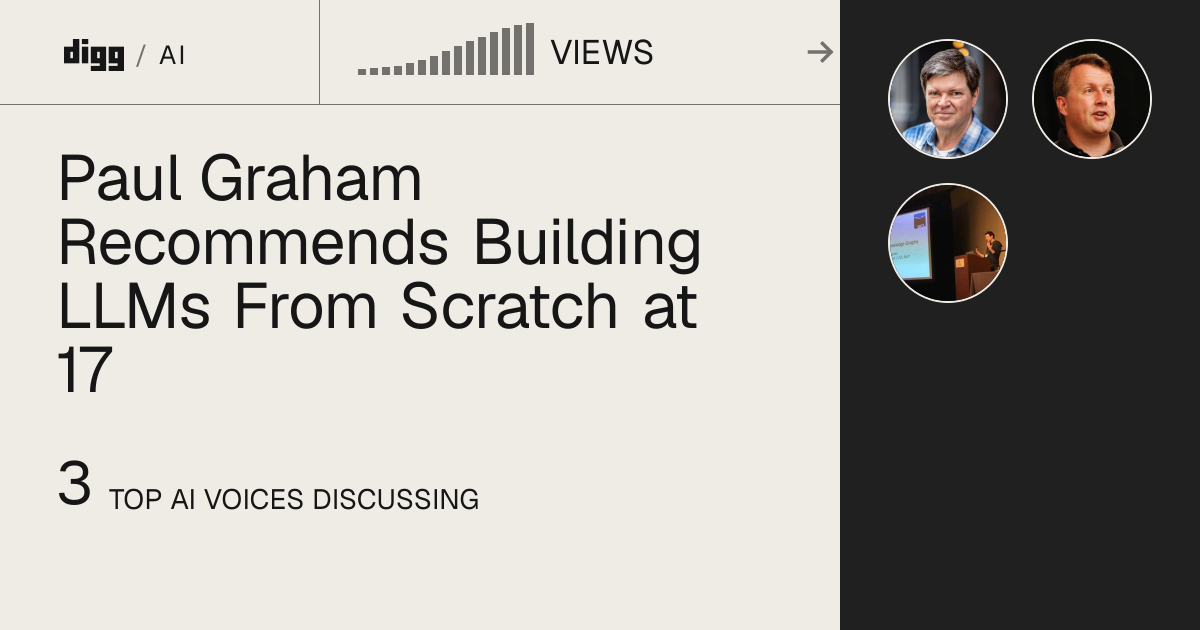
Paul Graham, a prominent figure in the tech world, recently shared a provocative piece of advice that has resonated across the industry: "Someone asked what I'd do if I were 17. I'd learn how to build LLMs from scratch, and then train ones as powerful as I could with whatever hardware I could get access to" (Source 1). This statement isn't just about technical skill; it's a profound call to understand the foundational elements of the technology shaping our future. For those navigating the complex landscape of AI, this deep dive into Large Language Models (LLMs) offers a strategic advantage, especially as we move towards more integrated human + AI collaboration within sophisticated AI offices like Nonilion, where AI agents become indispensable members of the team.
01The Provocation: Why "If I Were 17, I'd Learn How to Build LLMs From Scratch"
Paul Graham's counsel to a hypothetical 17-year-old underscores the immense value of foundational knowledge in a rapidly evolving field. His belief is that a deep understanding of LLMs, gained by building them from the ground up, would ultimately lead to superior startup ideas later on (Source 3). This perspective emphasizes mastery over superficial engagement, suggesting that true innovation stems from an intimate familiarity with the underlying mechanics of a technology.
Want your team to run this workflow with AI-native execution?
Rather than merely utilizing existing models, Graham advocates for a hands-on approach:
building, training, and iterating on them directly. That distinction matters. In AI, there is a world of difference between being a user of a model and being someone who understands why it behaves the way it does, how it fails, and what it takes to improve it.
02Why Building From Scratch Still Matters
At first glance, “build an LLM from scratch” can sound unrealistic. After all, the largest frontier models require enormous datasets, specialized hardware, and teams of researchers. But Graham’s point is not that every 17-year-old should replicate a frontier lab. It’s that the fastest way to gain real leverage in AI is to understand the full stack: data, tokenization, architecture, optimization, evaluation, and deployment.
That kind of understanding pays off in several ways:
You learn what actually makes models intelligent, rather than treating them like magic.
You develop intuition for tradeoffs between cost, performance, and reliability.
You become better at diagnosing failures, from hallucinations to prompt sensitivity.
You gain the ability to adapt to future model shifts instead of being locked into today’s tools.
This is especially important because AI is moving quickly from “cool demo” territory into operational infrastructure. The people who can build, tune, and reason about models will have an advantage not just in research, but in product, operations, and entrepreneurship.
03The Real Learning Curve: What “From Scratch” Actually Means
Learning to build an LLM from scratch does not necessarily mean starting with a massive cluster and billions of parameters. It means understanding the pipeline end to end.
A practical path might look like this:
1. Learn the fundamentals of neural networks
Before touching transformers, it helps to understand:
linear algebra
calculus basics
probability and statistics
gradient descent
backpropagation
overfitting and regularization
These are the mathematical building blocks behind modern deep learning. Without them, it’s easy to memorize terminology without understanding behavior.
2. Build a tiny language model
Start small. A character-level model or a miniature transformer trained on a small dataset can teach more than a thousand tutorials. Even a toy model reveals important ideas:
how text becomes tokens
how embeddings represent meaning
how attention helps models focus on context
how loss decreases during training
how generation works one token at a time
The goal is not performance. The goal is clarity.
3. Study data quality
A model is only as good as the data it learns from. Training data affects:
factual accuracy
style and tone
bias and toxicity
domain expertise
multilingual capability
This is one of the most overlooked lessons in AI. Many people assume model architecture is the main differentiator, but data curation often matters just as much, if not more.
4. Understand training dynamics
Once you train even a small model, you begin to see the practical realities of optimization:
learning rates that are too high destabilize training
batch size affects convergence and efficiency
poor initialization can slow learning
scaling model size without enough data can backfire
These are not abstract concerns. They shape the behavior of every serious LLM.
5. Evaluate honestly
A model that sounds impressive is not necessarily useful. Serious evaluation means checking:
accuracy on benchmark tasks
robustness to prompt variation
hallucination rate
latency and cost
behavior on edge cases
This is where many AI products fail. They look good in a demo but break in real workflows.
04Why This Skill Becomes a Startup Advantage
Paul Graham’s broader point is entrepreneurial. If you understand how LLMs work at a deep level, you are more likely to spot opportunities others miss.
For example, you might notice that a problem does not require a giant general-purpose model at all. It might be better solved with:
a smaller fine-tuned model
retrieval-augmented generation
a workflow agent with guardrails
a hybrid system combining rules and generation
domain-specific training data
That insight can save enormous time and money. It can also lead to better products.
Many early AI startups make the mistake of wrapping a generic model around a vague idea. The stronger approach is to identify a real workflow, understand its constraints, and then design the right model strategy for that environment. Someone who has built models from scratch is much more likely to make those distinctions.
There is also a deeper lesson in Graham’s advice: constraint is educational.
Training with whatever hardware you can access forces you to think carefully about efficiency. You learn to ask:
What is the smallest model that can solve this problem?
Which training tricks give the most improvement per dollar?
Where can I simplify without losing too much quality?
How do I make inference cheaper and faster?
These questions are increasingly important in a world where AI costs can scale quickly. A founder or engineer who understands resource constraints is better equipped to ship systems that are practical, not just impressive.
This is one reason small teams can still compete. They may not have the largest budgets, but they can often move faster, experiment more creatively, and build with sharper focus.
06From Model Builder to AI Systems Thinker
Building an LLM from scratch is not just about becoming a model researcher. It changes how you think about AI systems more broadly.
Once you understand the model itself, you start to see the surrounding ecosystem more clearly:
prompting is not the same as training
retrieval can be more useful than fine-tuning in many cases
orchestration matters when multiple tools are involved
memory and context management affect long-horizon tasks
safety and alignment are product concerns, not just research topics
This systems-level thinking is exactly what modern AI teams need. In an AI office environment, where models support real work, the challenge is not simply generating text. It is building dependable workflows that combine reasoning, search, memory, and human oversight.
07What This Means for Young Builders
For a 17-year-old, or anyone early in their career, this advice is not really about age. It is about timing. The AI era is still early enough that deep learners can still get ahead by mastering fundamentals before the field becomes fully standardized.
A good learning roadmap might include:
coding in Python comfortably
implementing a basic transformer
training on a small corpus
experimenting with fine-tuning
learning how tokenizers work
reading model papers critically
reproducing known results
deploying a small model as a real app
That combination of theory and practice creates durable skill. It also builds confidence. Once you have trained even a modest model yourself, AI stops feeling like a black box and starts feeling like an engineering discipline.
08The Broader Lesson: Don’t Just Use the Future, Understand It
Graham’s advice is ultimately about agency. The people who understand the machinery of AI will not only use the future; they will help shape it.
That matters for students, founders, researchers, and operators alike. Whether you want to build a startup, improve internal workflows, or contribute to the next generation of AI systems, the ability to reason from first principles is a major advantage.
And in a world where AI tools are becoming more accessible every month, the real differentiator will not be access alone. It will be understanding.
The next wave of value will likely come from people who can combine technical depth with practical judgment — people who know when to use a large model, when to use a small one, when to fine-tune, when to retrieve, and when to redesign the workflow entirely. That is the kind of mastery Paul Graham is pointing toward.
If you are young and serious about AI, the message is simple: learn the foundations, build the models, and study the tradeoffs. Not because it is trendy, but because it gives you the ability to create things others cannot.
In the age of LLMs, fluency is not enough. The real edge belongs to those who understand how the system works from the inside out.
For I were 17, I'd learn how to build LLMs from scratch, Nonilion can be used as the practical AI-office example: a shared workspace where human teammates and AI agents keep discussion, decisions, and execution connected.
10Why This Trend Matters for Nonilion
This trend matters to Nonilion because it points to a bigger change: teams are moving from simple calls toward persistent, AI-supported collaboration spaces. Nonilion can bridge live presence, meeting context, avatars, and follow-up work so the trend becomes a usable workflow instead of a headline.
11Shareable Extracts
The trend is not just "If I Were 17, I'd Learn How to Build LLMs From Scratch: Paul Graham's Vision for the Future of AI Mastery" - it is a signal that team coordination is becoming the next competitive edge.
Hot take: the teams that win from this shift will not be the ones with more meetings; they will be the ones with clearer shared context after every meeting.
If if i were 17, i'd learn how to build llms from scratch: paul graham's vision for the future of ai mastery keeps moving this fast, remote teams need a workspace where conversation, presence, and follow-up stay connected.
I'd learn how to build LLMs from scratch, and then train ones as powerful as I could with whatever hardware I could get access to" (Source 1).
This statement isn't just about technical skill; it's a profound call to understand the foundational elements of the technology shaping our future.
12Social Hooks
Everyone is talking about If I Were 17, I'd Learn How to Build LLMs From Scratch: Paul Graham's Vision for the Future of AI Mastery. The overlooked part is what happens to team workflows after the headline fades.
The uncomfortable question behind If I Were 17, I'd Learn How to Build LLMs From Scratch: Paul Graham's Vision for the Future of AI Mastery: are teams adapting their collaboration systems fast enough?
This is not a meeting trend. It is a coordination trend, and products like Nonilion sit right in the middle of that shift.
This article on I were 17, I'd learn how to build LLMs from scratch was generated by the Nonilion AI blog workflow using web research inputs and AI-assisted synthesis.