Home/Blog/Elevating AI Agent Capabilities: A Deep Dive into the DeepSeek Harness DSH Plugin Ecosystem
human + AI workflows
Elevating AI Agent Capabilities: A Deep Dive into the DeepSeek Harness DSH Plugin Ecosystem
Elevating AI Agent Capabilities: A Deep Dive into the DeepSeek Harness DSH Plugin Ecosystem In the rapidly evolving landscape of artificial intelligence, the concept of extensible
11 MIN READ
14 Aug 2026
human + AI workflows
Elevating AI Agent Capabilities: A Deep Dive into the DeepSeek Harness DSH Plugin Ecosystem
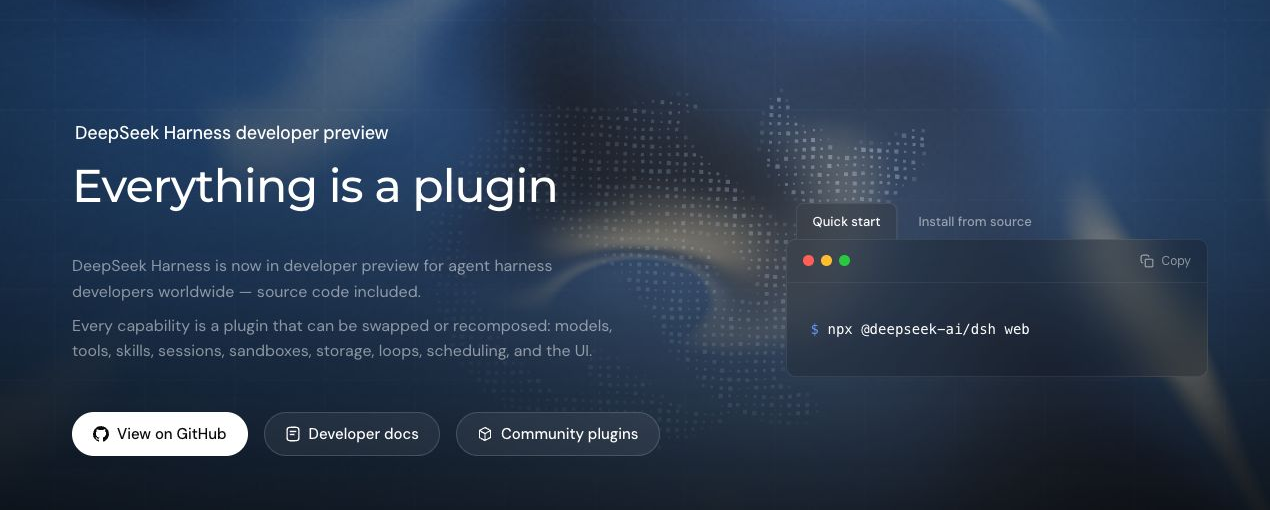
In the rapidly evolving landscape of artificial intelligence, the concept of extensible AI agents is transforming how we approach automation and collaboration. Central to this evolution is DeepSeek Harness (DSH), an open-source Agent OS designed to connect teams, AI agents, devices, and compute resources. The true power of DSH, however, lies in its vibrant and expanding ecosystem of dsh-plugin extensions. These plugins are not just add-ons; they are fundamental to unlocking the full potential of AI agents, enabling them to perform specialized tasks and integrate seamlessly into complex workflows, much like the advanced AI agents collaborating within a Nonilion virtual office environment.
01Understanding DeepSeek Harness and the Foundational Role of DSH Plugins
DeepSeek Harness (DSH) stands as a foundational open-source Agent OS, providing a CMA-compatible agent runtime that supports any model. It comes equipped with essential MCP tools, sandboxed sessions, audit capabilities, replay functions, and a local console, including a native DeepSeek Harness bundle over stdio MCP. This robust architecture forms the backbone for creating highly capable and adaptable AI agents.
Want your team to run this workflow with AI-native execution?
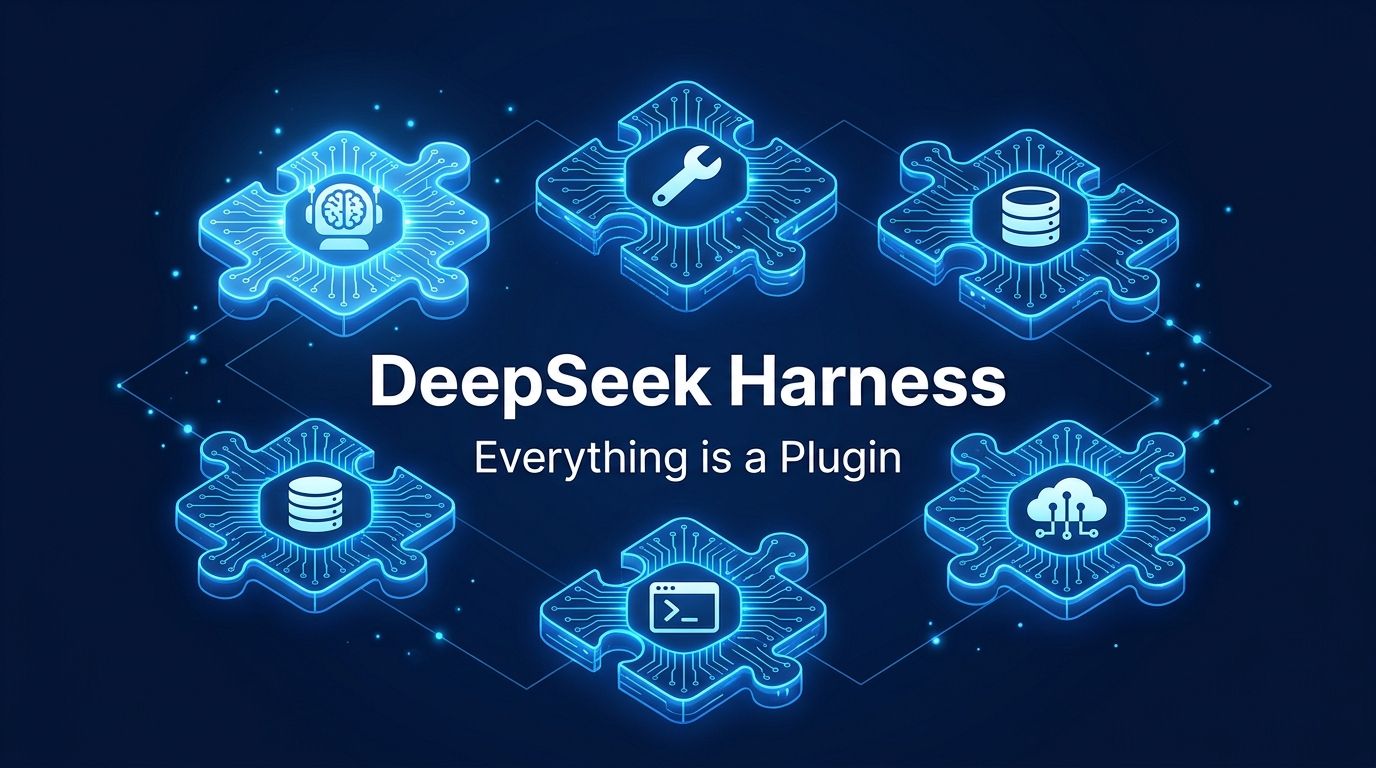
At the core of DSH's extensibility are dsh-plugins, which are essentially extension packages designed to enhance the functionality of DeepSeek Harness. These plugins are incredibly versatile, capable of adding a wide array of features and capabilities to DSH agents. For instance, they can introduce new model tools, provide specialized services, implement custom settings, or integrate novel interface panels. Furthermore, dsh-plugins can modify workflow behavior or even introduce complete profile enhancements, allowing agents to adapt to specific operational needs.
The significance of dsh-plugins cannot be overstated. They are the mechanism through which AI agents gain new senses and cognitive abilities. For example, some plugins can extend an agent's input capabilities, such as vision processing, while others can refine its reasoning prowess by influencing
tool selection, memory handling, or response formatting. In practice, this means a DSH-powered agent can move beyond generic chat interactions and become a task-specific operator that understands context, executes actions, and collaborates across systems.
A strong dsh-plugin does more than expose a single API call. It fits into the agent runtime in a way that feels native, predictable, and safe. That usually means the plugin is designed with a clear purpose, minimal friction during installation, and a well-defined boundary around what it can access.
In a production setting, the most valuable plugins tend to fall into a few broad categories:
Model augmentation plugins that improve how an agent reasons, routes tasks, or formats outputs
Tooling plugins that connect the agent to external systems such as CRMs, ticketing platforms, databases, or cloud services
Interface plugins that add panels, dashboards, or custom controls to the local console
Workflow plugins that automate recurring sequences of actions
Environment plugins that adapt the agent to a particular team, device, or deployment context
This modularity is especially important for organizations that want to scale AI usage without turning every agent into a one-off build. Instead of hardcoding behavior into a single prompt or monolithic application, teams can compose capabilities from reusable plugins and apply them where needed.
03How DSH Plugins Fit Into an Agent Workflow
A typical DSH workflow begins with an agent receiving a task, then deciding which tools or capabilities it should use to complete that task. A dsh-plugin can influence that process at several points.
For example, a plugin may:
Register a new tool that the agent can invoke during reasoning
Expose a service endpoint that other components can call
Add a UI element to help users inspect plugin state or trigger actions
Modify runtime behavior so the agent handles certain prompts differently
Provide profile-level configuration that changes how the agent behaves in a given workspace
This layered design allows a plugin to be both narrow and powerful. A single extension might only handle calendar lookups, while another could orchestrate an entire approval workflow across multiple systems. Because DSH is built around extensibility, these capabilities can be introduced without rebuilding the agent from scratch.
04Common Use Cases for DSH Plugins
One of the clearest ways to understand the value of the dsh-plugin ecosystem is to look at real-world use cases. In many teams, plugins are what make agents useful beyond experimentation.
1. Knowledge Retrieval and Search
A plugin can connect an agent to internal documentation, knowledge bases, or indexed file stores. This allows the agent to answer questions using organization-specific information rather than relying only on general model knowledge. For example, a support team might use a plugin that retrieves policy documents, product notes, or troubleshooting guides in real time.
2. Task Automation
Plugins can help agents perform repetitive operational work. That might include creating tickets, updating records, sending notifications, or generating reports. Instead of asking a human to copy data between systems, the agent can complete the sequence automatically after receiving a validated instruction.
3. Data Analysis
A dsh-plugin can connect an agent to analytics pipelines, spreadsheets, or databases. The agent can then summarize trends, surface anomalies, and produce natural-language explanations of structured data. This is useful for business operations, finance, product, and research teams that need quick interpretation rather than raw tables.
4. Collaboration and Coordination
In a multi-agent environment, plugins can help coordinate handoffs between agents or between agents and humans. One plugin might log task status, another might publish updates to a shared workspace, and a third might trigger follow-up actions when a milestone is reached. This makes DSH especially well suited to collaborative environments where multiple actors need visibility into the same workflow.
5. Custom Interfaces
Some plugins are designed to improve the user experience rather than the agent’s internal reasoning. These can add specialized panels, controls, or visualizations to the console so users can inspect state, review actions, or intervene when needed. In operational settings, this can make the difference between a useful prototype and a dependable internal tool.
05Designing Plugins for Reliability and Safety
Because plugins can extend agent behavior in powerful ways, they also introduce new risks. A poorly designed plugin can create inconsistent outputs, leak data, or make the agent harder to debug. For that reason, plugin design should prioritize reliability from the start.
A few practical principles matter most:
Keep permissions narrow. A plugin should only access the systems and data it truly needs.
Make behavior explicit. Hidden side effects are difficult to audit and even harder to trust.
Validate inputs carefully. Any external request, parameter, or file should be treated as untrusted.
Log important actions. Clear logs make it easier to trace what happened and why.
Fail gracefully. If a plugin cannot complete a task, it should return a useful error rather than breaking the workflow.
These principles are especially important in environments where agents interact with sensitive business data or execute actions on behalf of users. DSH’s sandboxed sessions and audit capabilities provide a strong foundation, but plugin authors still need to design with operational discipline.
06Building a Plugin-Oriented Agent Stack
A mature DSH deployment often treats plugins as part of a broader architecture rather than isolated features. In that model, the agent stack may include:
A core runtime that manages sessions and model access
A set of base tools provided by DSH
Several dsh-plugin extensions for domain-specific tasks
A local or remote interface for user interaction
Logging and replay mechanisms for review and debugging
This structure is useful because it separates concerns. The runtime handles execution, the plugins handle specialization, and the interface handles human interaction. As a result, teams can update one layer without destabilizing the others.
For example, a customer support agent might use one plugin to retrieve account data, another to draft responses, and a third to escalate issues based on sentiment or severity. Each plugin has a distinct responsibility, but together they create a cohesive workflow. That is the real promise of the DSH ecosystem: composability without unnecessary complexity.
07Choosing the Right Plugin Strategy
Not every capability needs to be a plugin, and not every plugin should be broadly reusable. In practice, teams should decide whether a feature belongs in the core agent prompt, in a shared plugin, or in a specialized extension for a single workflow.
A useful rule of thumb is:
Put universal behavior in the core agent configuration
Put reusable functionality in a shared dsh-plugin
Put highly specific logic in a narrowly scoped plugin
This approach keeps the system maintainable. It also reduces the risk of overengineering, where every small behavior becomes a separate extension. The best plugin ecosystems are curated, not bloated. They grow in response to real operational needs, not speculative ones.
08The Future of DSH Plugins
As agent platforms mature, the role of plugins will likely become even more central. Users will expect agents to connect to more tools, understand more contexts, and operate across more environments with less manual setup. That means plugin ecosystems will need to support stronger versioning, better discovery, clearer permissions, and more standardized interfaces.
For DSH specifically, the plugin model points toward a future where agents are not defined primarily by prompts, but by capabilities. A well-equipped agent will be the product of its runtime, its model, and the plugins that extend it. In that sense, dsh-plugin is not just a technical feature; it is the mechanism that turns a general-purpose agent into a specialized digital coworker.
09Practical Takeaway
If you are evaluating DeepSeek Harness for real-world use, the plugin ecosystem should be one of your first considerations. The core runtime provides the foundation, but dsh-plugin extensions are what make the system adaptable, scalable, and genuinely useful in day-to-day operations. Whether the goal is automation, knowledge access, collaboration, or interface customization, plugins are the bridge between a capable model and a production-ready agent experience.
For dsh-plugin, Nonilion can be used as the practical AI-office example: a shared workspace where human teammates and AI agents keep discussion, decisions, and execution connected.
10Why This Trend Matters for Nonilion
This trend matters to Nonilion because it points to a bigger change: teams are moving from simple calls toward persistent, AI-supported collaboration spaces. Nonilion can bridge live presence, meeting context, avatars, and follow-up work so the trend becomes a usable workflow instead of a headline.
11Shareable Extracts
The trend is not just "Elevating AI Agent Capabilities: A Deep Dive into the DeepSeek Harness DSH Plugin Ecosystem" - it is a signal that team coordination is becoming the next competitive edge.
Hot take: the teams that win from this shift will not be the ones with more meetings; they will be the ones with clearer shared context after every meeting.
If elevating ai agent capabilities: a deep dive into the deepseek harness dsh plugin ecosystem keeps moving this fast, remote teams need a workspace where conversation, presence, and follow-up stay connected.
Central to this evolution is DeepSeek Harness (DSH), an open-source Agent OS designed to connect teams, AI agents, devices, and compute resources.
The true power of DSH, however, lies in its vibrant and expanding ecosystem of dsh-plugin extensions.
12Social Hooks
Everyone is talking about Elevating AI Agent Capabilities: A Deep Dive into the DeepSeek Harness DSH Plugin Ecosystem. The overlooked part is what happens to team workflows after the headline fades.
The uncomfortable question behind Elevating AI Agent Capabilities: A Deep Dive into the DeepSeek Harness DSH Plugin Ecosystem: are teams adapting their collaboration systems fast enough?
This is not a meeting trend. It is a coordination trend, and products like Nonilion sit right in the middle of that shift.