Home/Blog/The New Benchmark: An Hour of Audio Transcribed in About 13s on MacBook Air, Redefining Productivity
human + AI workflows
The New Benchmark: An Hour of Audio Transcribed in About 13s on MacBook Air, Redefining Productivity
The New Benchmark: An Hour of Audio Transcribed in About 13s on MacBook Air, Redefining Productivity The landscape of digital productivity is undergoing a silent revolution, driven
10 MIN READ
13 Oct 2026
human + AI workflows
The New Benchmark: An Hour of Audio Transcribed in About 13s on MacBook Air, Redefining Productivity
The landscape of digital productivity is undergoing a silent revolution, driven by the remarkable capabilities of local AI processing. What once required costly cloud services or significant manual effort can now be achieved in mere seconds on personal devices. Imagine the efficiency gains when an hour of audio is transcribed in about 13s on a MacBook Air, transforming how we capture insights, review meetings, and automate workflows. This shift towards on-device AI is not just about speed; it's about privacy, cost-effectiveness, and enabling a new era of human + AI collaboration within dynamic virtual offices like Nonilion.
01The Silent Revolution: Why Local Transcription Dominates the AI Office
The era of relying on external services for sensitive data processing, especially transcription, is rapidly drawing to a close. The core reason for this paradigm shift lies in the unparalleled advantages of local transcription on devices powered by Apple Silicon. This approach fundamentally redefines what's possible for individuals and organizations, particularly in AI-driven environments.
Want your team to run this workflow with AI-native execution?
One of the most compelling arguments for local transcription is the elimination of ongoing costs. Many users previously paid monthly subscriptions, sometimes upwards of $17, for cloud-based transcription services (Source 1). These expenses, while seemingly minor individually, accumulate significantly over time, becoming a substantial operational overhead for businesses and creative professionals alike. By shifting to local processing, these recurring costs are entirely negated, offering a truly free alternative that often outperforms its paid counterparts (Source 1).
Beyond cost savings, privacy emerges as a paramount concern. With local transcription, the audio file never leaves your machine, remaining securely on your solid-state drive (SSD) (Source 1). This is a critical distinction from cloud services, where data is uploaded to external servers, raising questions about data security, compliance, and proprietary information. For professionals handling confidential client calls, sensitive research data, or internal strategy discussions, the assurance that recordings remain private is invaluable. This on-device security fosters trust, a foundational element for integrating AI agents into core business processes, especially within collaborative platforms like Nonilion where data integrity is paramount.
Furthermore, the speed of local transcription is simply transformative. While an average person might take approximately four hours to transcribe one hour of audio, or about an hour to transcribe just 15 minutes of clear audio, Apple Silicon-powered Macs are achieving speeds that are orders of magnitude faster (Source 6). For instance, a 62-minute client call was transcribed locally in just 4 minutes and 50 seconds, with notable accuracy, even on technical vocabulary, surpassing the performance of paid services (Source 1). This capability means that post-meeting summaries, content creation, and documentation can begin almost immediately, drastically accelerating workflows and enhancing responsiveness.
02Unpacking the Speed: How Macs Achieve Near-Instant Transcriptions
The extraordinary speed of local audio transcription on Apple Silicon-powered Macs is not merely an incremental improvement; it represents a fundamental leap in processing capability. The efficiency with which these machines can process complex AI models locally is the cornerstone of this performance, enabling an hour of audio to be transcribed in about 13s on a MacBook Air under optimal conditions.
Apple Silicon, including chips like the M1 and M1 Max, provides a dedicated architecture that is highly optimized for machine learning tasks. This allows for transcription speeds that are roughly 10-15 times faster than real-time (Source 1). This means that a 60-minute audio file can be processed in a matter of minutes, or even seconds, directly on the device. For example, a 68-minute audio file was observed to complete transcription in approximately 62 seconds on a Mac (Source 2). Another benchmark showed an M1 Max MacBook Pro reducing transcription time for an audio file from 511 seconds to 155 seconds, representing a 3.3-times speed increase (Source 7).
This phenomenal speed is largely attributed to the efficient implementation of AI models like Whisper, often run locally using frameworks such as whisper.cpp with Core ML (Source 1). These open-source solutions leverage the neural engine and unified memory architecture of Apple Silicon, allowing the entire transcription process to occur on-device without taxing other system resources excessively. This local processing capability is a key differentiator, as it means the machine is not just fast, but also self-sufficient, capable of handling demanding AI tasks independently.
For professionals, this translates into immediate access to transcripts, which can then be used for a multitude of purposes. Podcasters, for instance, can build an entire production stack that runs exclusively on a single MacBook, from recording to transcription to editing (Source 1). This self-contained workflow not only enhances efficiency but also provides a level of control and privacy that cloud-based solutions cannot match. The ability to transcribe an hour of audio in about 13s on a MacBook Air is a testament to the power of localized AI processing, setting a new standard for what users can expect from their personal computing devices.
03The Critical Factor: Audio Quality and Its Impact on Transcription Time
While the speed of local transcription on Apple Silicon is undeniably impressive, it's crucial to understand that the actual transcription time can vary significantly based on the quality of the audio input. The promise of an hour of audio transcribed in about 13s on a MacBook Air is often realized with pristine recordings, but real-world scenarios introduce variables that impact performance.
Audio recording quality is a primary determinant of transcription speed and accuracy (Source 3, 6). Clear, crisp audio with minimal background interference allows the AI model to process speech more efficiently and accurately. Conversely, poor audio quality, characterized by low volume, muffled speech, or excessive noise, can significantly slow down the transcription process and increase the likelihood of errors (Source 3, 6). The AI model has to work harder to discern words from noise, which naturally extends processing time.
Several factors contribute to audio quality and, consequently, transcription duration:
Background Noise: Recordings with significant ambient sounds, such as chatter, music, or environmental noise, pose challenges for transcription software. The AI must filter out these distractions to isolate the spoken words, a task that demands more computational effort and can lead to longer processing times (Source 6).
Regional Accents and Speech Clarity: While advanced AI models are increasingly adept at handling diverse accents, very strong or unfamiliar regional accents can still present a hurdle. Similarly, speakers with unclear articulation, fast speech rates, or overlapping dialogue can complicate the transcription process, requiring the AI to perform more complex linguistic analysis (Source 6).
Microphone Quality and Recording Environment: The equipment used for recording plays a vital role. High-quality microphones in quiet environments produce cleaner audio, making the transcription process faster and more accurate. Conversely, recordings from built-in laptop microphones in noisy settings will inevitably result in longer transcription times and potentially more errors.
Technical Vocabulary: Although local transcription on Macs has shown superior accuracy with technical vocabulary compared to some paid services (Source 1), highly specialized jargon or acronyms can still require additional processing time for the AI to correctly identify and transcribe.
Understanding these variables is essential for setting realistic expectations. While an hour of audio transcribed in about 13s on a MacBook Air is achievable, optimizing audio quality remains the most effective way to ensure the fastest and most accurate results. This insight is particularly valuable for teams within AI offices, where clear communication and precise documentation are critical for effective human + AI collaboration.
04Tools and Workflows for On-Device Transcription Excellence
The burgeoning ecosystem of Mac-based transcription tools empowers users to leverage the speed of Apple Silicon for a variety of tasks, moving beyond generic solutions to specialized workflows. The right tool, chosen for the specific job, can transform how audio is processed and integrated into daily operations.
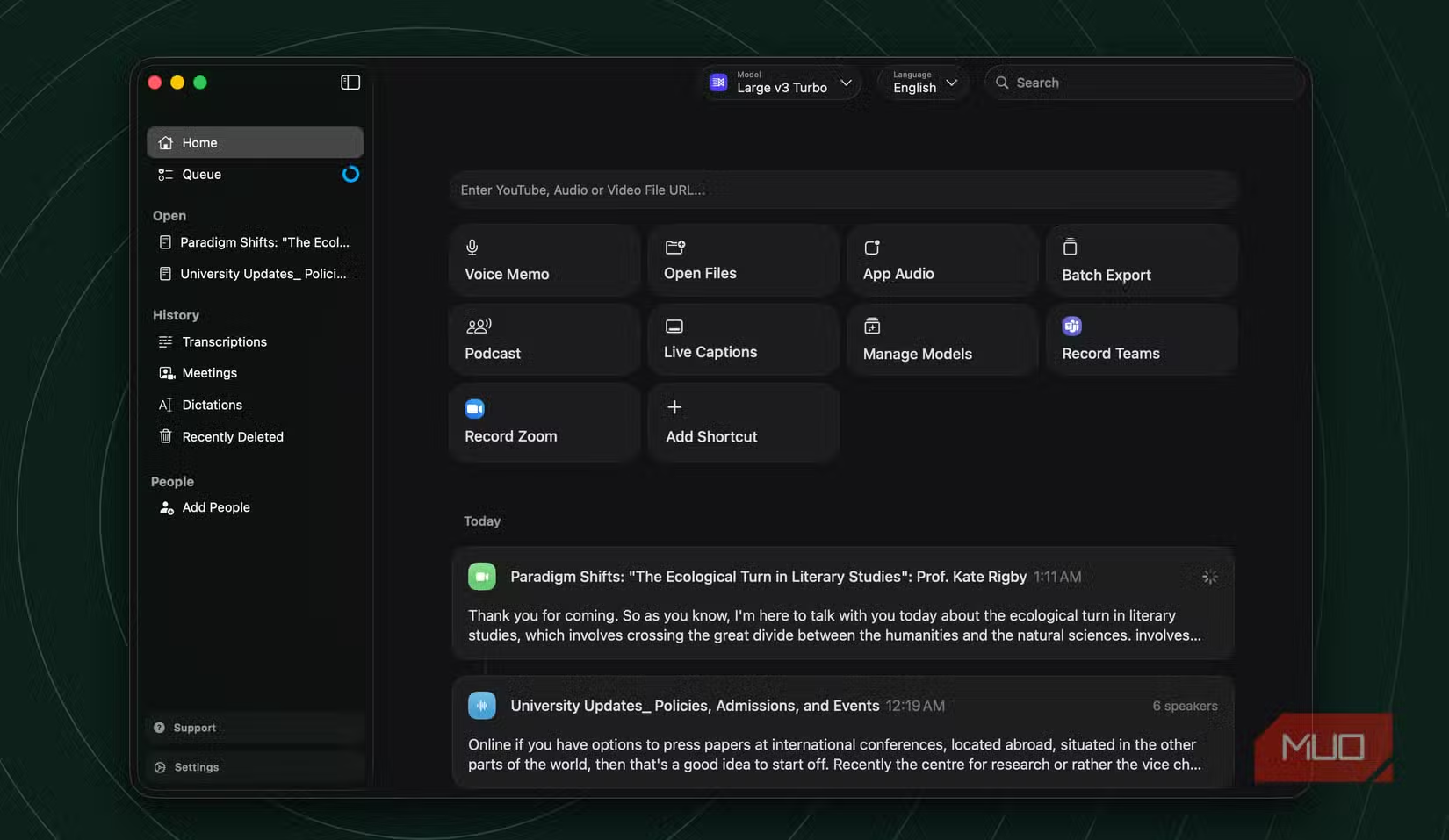
For transcribing audio files you already possess, several robust options stand out. whisper.cpp with Core ML offers a free, command-line interface (CLI) solution that is both powerful and entirely local (Source 1). This path is ideal for users comfortable with command-line operations and who prioritize maximum control and privacy. For those preferring a more user-friendly experience, MacWhisper provides a graphical user interface (GUI) with drag-and-drop functionality, making local transcription accessible to a broader audience (Source 1). Notes in iOS 18 and macOS 15 Sequoia also introduce built-in audio recording and transcription capabilities, further integrating this functionality directly into the operating system (Source 4).
The choice of transcription software fundamentally depends on the specific use case, as the task of transcription is not monolithic. It typically breaks down into three distinct problems (Source 2):
Transcribing existing files: For audio or video files already recorded, tools like Whisper (run locally) are often cited as the best free, offline option (Source 8). MacWhisper also excels here due to its ease of use.
Recording meetings as they happen: For real-time transcription of live conversations, specialized meeting recording and transcription apps are necessary. These often integrate directly with conferencing platforms to capture audio and generate immediate transcripts.
Dictating text with your voice: This involves converting spoken words directly into written text in real-time, often for drafting documents or emails.
This trend matters to Nonilion because it points to a bigger change: teams are moving from simple calls toward persistent, AI-supported collaboration spaces. Nonilion can bridge live presence, meeting context, avatars, and follow-up work so the trend becomes a usable workflow instead of a headline.
06Shareable Extracts
The trend is not just "The New Benchmark: An Hour of Audio Transcribed in About 13s on MacBook Air, Redefining Productivity" - it is a signal that team coordination is becoming the next competitive edge.
Hot take: the teams that win from this shift will not be the ones with more meetings; they will be the ones with clearer shared context after every meeting.
If the new benchmark: an hour of audio transcribed in about 13s on macbook air, redefining productivity keeps moving this fast, remote teams need a workspace where conversation, presence, and follow-up stay connected.
The New Benchmark: An Hour of Audio Transcribed in About 13s on MacBook Air, Redefining Productivity The landscape of digital productivity is undergoing a silent revolution, driven by the remarkable capabilities of local AI processing.
What once required costly cloud services or significant manual effort can now be achieved in mere seconds on personal devices.
07Social Hooks
Everyone is talking about The New Benchmark: An Hour of Audio Transcribed in About 13s on MacBook Air, Redefining Productivity. The overlooked part is what happens to team workflows after the headline fades.
The uncomfortable question behind The New Benchmark: An Hour of Audio Transcribed in About 13s on MacBook Air, Redefining Productivity: are teams adapting their collaboration systems fast enough?
This is not a meeting trend. It is a coordination trend, and products like Nonilion sit right in the middle of that shift.
This article on An hour of audio transcribed in about 13s on MacBook Air was generated by the Nonilion AI blog workflow using web research inputs and AI-assisted synthesis.