Home/Blog/Qwen3.8-Flash-Next: Architecting the Future of AI Agents in the Virtual Office
virtual coworking
Qwen3.8-Flash-Next: Architecting the Future of AI Agents in the Virtual Office
Qwen3.8-Flash-Next: Architecting the Future of AI Agents in the Virtual Office The advent of advanced AI models like Qwen3.8-Flash-Next marks a pivotal moment in the evolution of a
14 MIN READ
27 Aug 2026
virtual coworking
Qwen3.8-Flash-Next: Architecting the Future of AI Agents in the Virtual Office
The advent of advanced AI models like Qwen3.8-Flash-Next marks a pivotal moment in the evolution of artificial intelligence, promising to redefine the capabilities of AI agents and reshape the landscape of digital collaboration. This multimodal, ultra-sparse Mixture-of-Experts (MoE) model represents a significant leap forward, offering a sophisticated architecture designed for complex problem-solving and enhanced performance in areas critical for the modern AI-driven workspace. Its unique design and operational efficiencies are setting new benchmarks for what AI can achieve, especially when integrated into collaborative virtual environments.
01Unpacking Qwen3.8-Flash-Next: A New Paradigm in AI Architecture
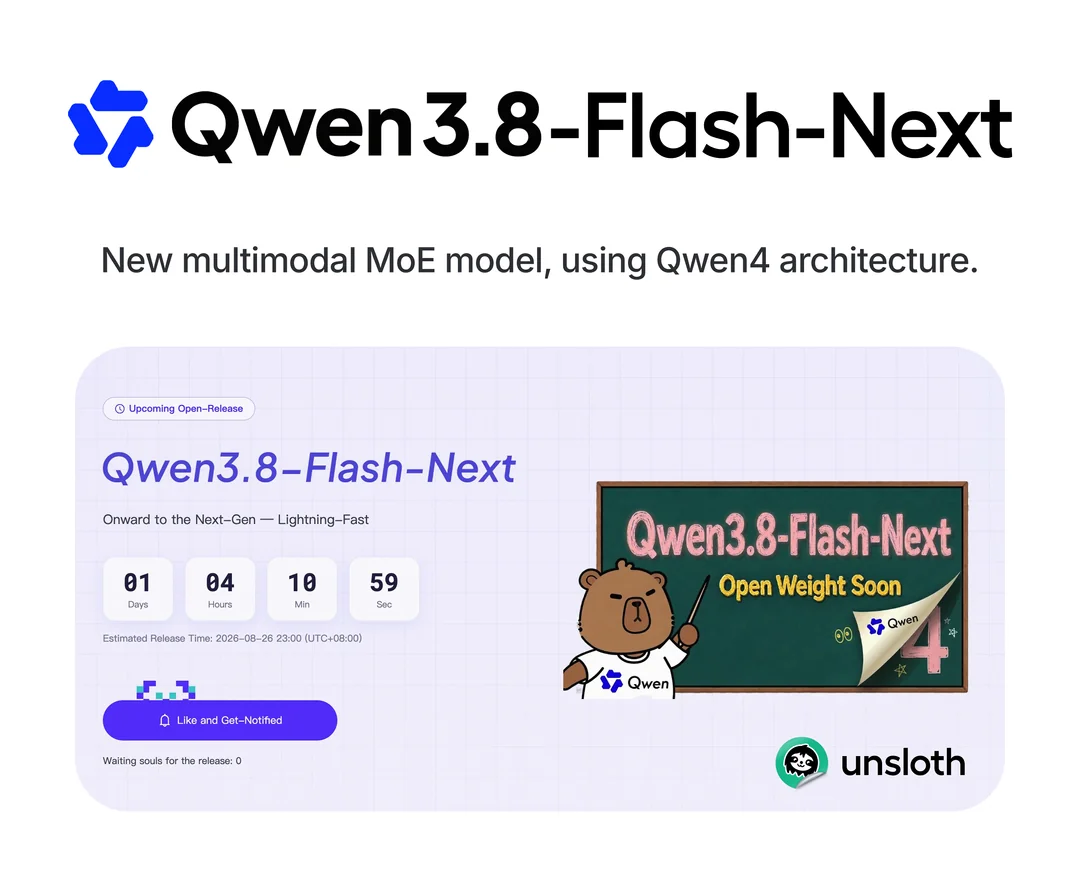
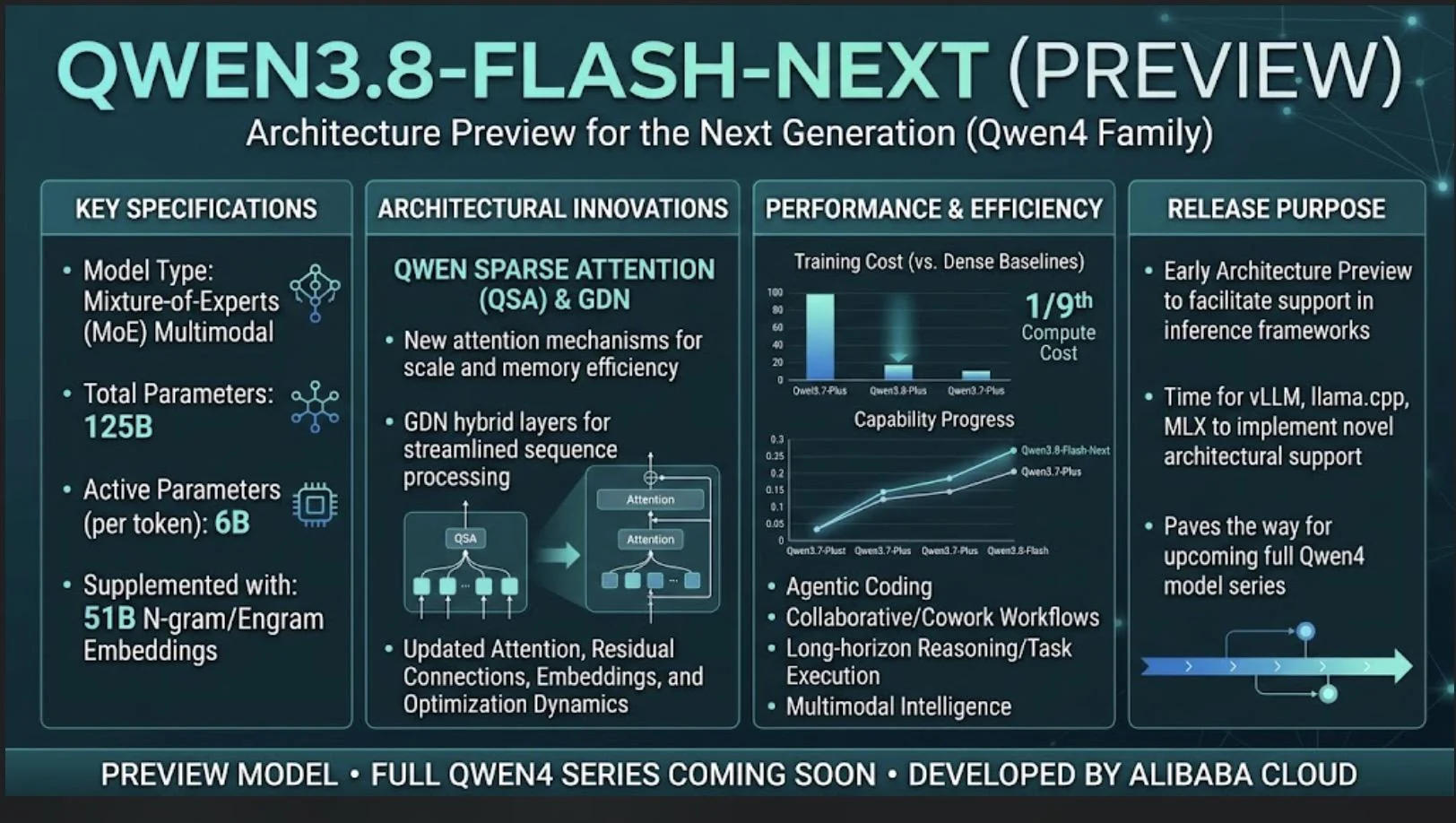
Qwen3.8-Flash-Next stands out as a groundbreaking multimodal, ultra-sparse Mixture-of-Experts (MoE) model, fundamentally extending the hybrid architecture first introduced in Qwen3-Next. This extension is applied across four critical dimensions: attention, residual connections, embedding strategies, and overall optimization [S1, S2, S6]. At its core, Qwen3.8-Flash-Next features an impressive 125 billion-parameter main model, which is further augmented by an additional 51 billion N-gram embedding table [S2, S5, S6].
Want your team to run this workflow with AI-native execution?
What makes this architecture particularly innovative is its sparse activation mechanism. Despite its vast parameter count, Qwen3.8-Flash-Next activates only 6 billion parameters per token during operation [S2, S5, S6]. This ultra-sparse approach allows the model to harness the power of a massive parameter space while maintaining computational efficiency, a crucial factor for deploying advanced AI agents in real-world scenarios. The model's design enables it to achieve comparable capabilities to its predecessor, Qwen3.7-Plus, yet it demonstrates superior performance in specialized domains such as coding and 'cowork' tasks, indicating a refined ability to handle intricate, collaborative challenges [S4]. Furthermore, Qwen3.8-Flash-Next boasts an expansive 262K context window, providing AI agents with a broad understanding of ongoing interactions and data [S8].
02The Strategic Advantage: Architectural Innovations of Qwen3.8-Flash-Next
The architectural innovations within Qwen3.8-Flash-Next are not merely incremental; they represent a strategic re-imagining of how large language models are constructed and optimized for performance. The extension of the hybrid architecture across attention, residual connections, embedding, and optimization is central to its enhanced capabilities [S1].
Attention Mechanisms: Refinements in attention allow the model to more effectively weigh and process information from its extensive context window, leading to more coherent and relevant outputs. This is vital for AI agents that need to maintain context across long conversations or complex project workflows.
Residual Connections: Improvements in residual pathways ensure that information flows more smoothly through the deep network layers, mitigating issues like vanishing gradients and enabling the model to learn more effectively from diverse data inputs.
Embedding Strategies: The integration of a substantial 51 billion N-gram embedding table alongside the main 125 billion parameters provides a richer, more nuanced understanding of language and concepts [S2, S5, S6]. This depth of understanding is crucial for multimodal capabilities, allowing AI agents to interpret and generate content across various data types.
Optimization Techniques: The overarching optimization strategies, including the sparse activation of only 6 billion parameters per token, are key to achieving high performance without prohibitive computational costs [S2, S5, S6]. This efficiency is paramount for deploying powerful AI agents at scale, enabling them to operate swiftly and economically within virtual environments.
These architectural choices collectively empower Qwen3.8-Flash-Next to tackle complex tasks with greater precision and efficiency. For AI agents, this means a higher capacity for sophisticated reasoning, improved contextual awareness, and the ability to seamlessly integrate multimodal information, laying the groundwork for more intelligent and versatile digital collaborators.
03Empowering AI Agents: Capabilities and Controllable Thinking with Qwen3.8-Flash-Next
Qwen3.8-Flash-Next introduces a suite of capabilities and control mechanisms that significantly elevate the potential of AI agents, particularly in dynamic and collaborative environments. Its multimodal nature allows agents to process and generate information across various formats, from text to code, enabling a more comprehensive understanding and interaction with tasks [S2, S6]. This is especially beneficial for
04From Model to Teammate: What Qwen3.8-Flash-Next Changes in Practice
For virtual-office AI agents, the most important shift is not simply that the model is larger or faster. It is that the model is better suited to participating in work rather than only responding to prompts. In a collaborative environment, an agent must do more than answer questions: it must track goals, interpret partial instructions, recover from ambiguity, and decide when to ask for clarification. Qwen3.8-Flash-Next is designed with these demands in mind.
One of its most useful qualities is controllable thinking [S2, S6]. This gives system designers a way to tune how the model approaches a task. For straightforward requests, an agent can respond quickly and directly. For more complex workflows, it can allocate more deliberation to planning, verification, and structured reasoning. In a virtual office, that flexibility matters because not every task deserves the same level of cognitive effort. Drafting a meeting summary, for example, should be fast; reconciling conflicting project updates or debugging a workflow may require deeper analysis.
This controllability also helps organizations balance latency, cost, and quality. A customer-facing assistant might need to answer in near real time, while an internal research agent can spend more time synthesizing information. By making reasoning behavior more adjustable, Qwen3.8-Flash-Next supports both lightweight and high-stakes use cases without forcing teams to deploy separate models for every scenario.
05Why the 262K Context Window Matters for Virtual Work
The 262K context window is one of the model’s most practical advantages [S8]. In a real office setting, information is rarely isolated. A single task may involve a long chat history, a project brief, a spreadsheet, policy documents, code snippets, and prior decisions made across multiple meetings. Traditional models often lose track of these dependencies, which creates friction and errors.
With a much larger context window, Qwen3.8-Flash-Next can maintain continuity across extended interactions. That means an agent can:
track evolving requirements across a long project thread
reference earlier decisions without being re-prompted
compare multiple documents in one pass
preserve stylistic or procedural constraints over time
support multi-step planning without constant context resets
This is especially valuable in asynchronous collaboration. Teams often leave fragmented instructions across channels, documents, and task trackers. An AI agent powered by Qwen3.8-Flash-Next can act as a continuity layer, helping people reconnect those fragments into a coherent operational picture.
06Multimodal Intelligence in the Virtual Office
Modern work is inherently multimodal. Employees do not just exchange text; they share screenshots, charts, tables, code, audio notes, and visual mockups. Qwen3.8-Flash-Next’s multimodal design makes it more adaptable to this reality [S2, S6].
In a virtual office, this can translate into several high-value workflows:
Document analysis
An agent can review contracts, internal policies, or technical specifications and extract actionable points. Instead of merely summarizing text, it can identify inconsistencies, missing sections, and dependencies that matter for downstream work.
Visual interpretation
If a teammate uploads a dashboard screenshot or product mockup, the agent can help interpret what is shown, describe trends, or compare layout options. This is useful for operations, design reviews, and stakeholder updates.
Code and technical support
Because Qwen3.8-Flash-Next shows strong performance in coding tasks [S4], it is well positioned to assist developers with code explanation, refactoring suggestions, test generation, and debugging support. In a virtual office, that makes it more than a chatbot; it becomes a technical collaborator that can work alongside engineering, QA, and product teams.
Cross-format reasoning
The real advantage of multimodality is not isolated perception, but synthesis. An agent can read a meeting transcript, inspect a spreadsheet, and generate a concise action plan that aligns with both the conversation and the data. This is the kind of cross-format reasoning that turns an AI system into a practical office assistant.
07Performance Where It Counts: Coding, Collaboration, and Complex Tasks
Qwen3.8-Flash-Next reportedly matches the general capability level of Qwen3.7-Plus while outperforming it in coding and cowork-oriented tasks [S4]. That distinction is important because virtual-office AI is increasingly judged by how well it supports workflows, not just language fluency.
In coding environments, the model’s sparse MoE design can be especially beneficial. Code tasks often require precision, long-range dependency tracking, and structured output. A model that can selectively activate the most relevant experts may be better equipped to handle these demands without wasting compute on irrelevant pathways. For developers, that can mean more reliable code generation, better handling of repository context, and stronger support for multi-file reasoning.
In cowork scenarios, the model’s value lies in coordination. It can help draft follow-up messages, summarize action items, organize priorities, and maintain alignment across teams. For example, after a product planning meeting, an AI agent could:
summarize decisions and open questions
assign follow-up tasks by role
draft a status update for leadership
identify dependencies that could delay delivery
flag missing information for the next meeting
This kind of operational support reduces administrative overhead and helps teams stay focused on higher-value work.
08Sparse MoE at Scale: Efficiency Without Sacrificing Capability
The ultra-sparse Mixture-of-Experts structure is not just a technical novelty; it is a deployment strategy [S2, S5, S6]. By activating only a fraction of the total parameters per token, Qwen3.8-Flash-Next can deliver high-end performance while controlling inference costs. That is especially relevant for enterprise environments, where AI usage may scale across thousands of employees and many simultaneous workflows.
This efficiency has several downstream benefits:
Lower serving costs: fewer active parameters can reduce compute demands per request
Better throughput: systems can handle more concurrent users or agents
More flexible deployment: organizations can use the model in larger, more interactive settings
Improved specialization: expert routing can support stronger performance on different task types
For virtual-office platforms, these advantages matter because AI is rarely used in isolation. It is embedded in calendars, chat tools, document systems, CRM platforms, and internal knowledge bases. A cost-efficient model architecture makes it more realistic to deploy AI across all of these touchpoints without creating unsustainable infrastructure pressure.
09Building Reliable AI Agents Around Qwen3.8-Flash-Next
A capable model is only one part of an effective AI agent. To function well in a virtual office, Qwen3.8-Flash-Next needs to be paired with memory systems, retrieval tools, permissions, and workflow orchestration. The model’s long context and controllable thinking make it a strong core, but the surrounding system determines how useful it becomes in practice.
A robust agent stack might include:
Retrieval-augmented generation for pulling in fresh company knowledge
Tool use for calendar actions, file operations, or database queries
Memory layers for retaining user preferences and project history
Guardrails for compliance, privacy, and approval workflows
Evaluation loops to monitor accuracy, tone, and task completion
In this setup, Qwen3.8-Flash-Next can serve as the reasoning engine while external tools handle execution. That separation is important. It allows developers to keep the model focused on interpretation and decision-making while ensuring that sensitive actions are validated by the surrounding application logic.
10Practical Use Cases in the Virtual Office
The most compelling applications of Qwen3.8-Flash-Next emerge when it is embedded into everyday work patterns. A few examples illustrate the range of possibilities.
Executive assistance
An AI agent can monitor schedules, prepare briefings, summarize inbox threads, and generate talking points before meetings. With a large context window, it can keep track of ongoing priorities across weeks rather than just single conversations.
Project management
The model can help turn meeting notes into task lists, detect blockers, and produce progress summaries. It can also compare current status against earlier milestones and highlight drift.
Knowledge management
Inside a company wiki or document hub, the agent can answer questions using internal materials, surface relevant files, and help employees find the right source of truth faster.
Sales and customer operations
The model can draft follow-up emails, summarize account histories, and assist with proposal preparation. Its ability to reason over long context makes it useful for maintaining continuity across customer interactions.
Engineering productivity
From code review support to incident summaries, Qwen3.8-Flash-Next can help technical teams move faster while preserving accuracy and traceability.
11The Broader Significance for AI-Driven Work
Qwen3.8-Flash-Next reflects a broader trend in AI: the move from generic chat interfaces toward specialized, agentic systems that participate in work. Its architecture suggests that future models will be judged not only by benchmark scores, but by how well they fit into the rhythms of real organizations.
That means the next generation of AI will likely need to excel in three areas at once:
Reasoning quality for complex decision-making
Operational efficiency for scalable deployment
Context awareness for long-running collaboration
Qwen3.8-Flash-Next is notable because it addresses all three. Its sparse MoE design supports efficiency, its controllable thinking supports reasoning flexibility, and its long context window supports continuity. Together, these features make it a strong candidate for the kind of AI agent infrastructure that modern virtual offices increasingly require.
12Looking Ahead
As virtual work becomes more distributed and more information-dense, the demand for intelligent coordination will only grow. Models like Qwen3.8-Flash-Next point toward a future where AI agents are not limited to answering isolated questions, but can actively manage context, support decisions, and collaborate across tools and teams.
For organizations exploring AI adoption, the key question is no longer whether a model can generate fluent text. It is whether the model can reliably operate inside real workflows. In that respect, Qwen3.8-Flash-Next offers a compelling blueprint: large-scale capability, efficient inference, multimodal understanding, and the kind of controllable reasoning that makes agentic systems genuinely useful.
In the virtual office of the future, that combination may prove to be the difference between an AI that merely assists and one that truly collaborates.
For Qwen3.8-Flash-Next, Nonilion can be used as the practical AI-office example: a shared workspace where human teammates and AI agents keep discussion, decisions, and execution connected.
The reason Qwen3.8-Flash-Next keeps returning to Nonilion is simple: the topic becomes more useful when it turns into coordinated work, not just another article, chat, or dashboard.
13Why This Trend Matters for Nonilion
This trend matters to Nonilion because it points to a bigger change: teams are moving from simple calls toward persistent, AI-supported collaboration spaces. Nonilion can bridge live presence, meeting context, avatars, and follow-up work so the trend becomes a usable workflow instead of a headline.
14Shareable Extracts
The trend is not just "Qwen3.8-Flash-Next: Architecting the Future of AI Agents in the Virtual Office" - it is a signal that team coordination is becoming the next competitive edge.
Hot take: the teams that win from this shift will not be the ones with more meetings; they will be the ones with clearer shared context after every meeting.
If qwen3.8-flash-next: architecting the future of ai agents in the virtual office keeps moving this fast, remote teams need a workspace where conversation, presence, and follow-up stay connected.
Its unique design and operational efficiencies are setting new benchmarks for what AI can achieve, especially when integrated into collaborative virtual environments.
This extension is applied across four critical dimensions: attention, residual connections, embedding strategies, and overall optimization [S1, S2, S6].
15Social Hooks
Everyone is talking about Qwen3.8-Flash-Next: Architecting the Future of AI Agents in the Virtual Office. The overlooked part is what happens to team workflows after the headline fades.
The uncomfortable question behind Qwen3.8-Flash-Next: Architecting the Future of AI Agents in the Virtual Office: are teams adapting their collaboration systems fast enough?
This is not a meeting trend. It is a coordination trend, and products like Nonilion sit right in the middle of that shift.
16Sources and Author
Sources
Qwen3.8-Flash-Next: A New Architecture, Towards ...
qwen.ai/blog