Home/Blog/Decoding the 2027 Social Security COLA: Strategic Insights for a Future-Forward Workforce
Developer Productivity
Decoding the 2027 Social Security COLA: Strategic Insights for a Future-Forward Workforce
Decoding the 2027 Social Security COLA: Strategic Insights for a Future-Forward Workforce The landscape of retirement planning is continuously shaped by economic forces, with the S
9 MIN READ
03 Aug 2026
Developer Productivity
Decoding the 2027 Social Security COLA: Strategic Insights for a Future-Forward Workforce
The landscape of retirement planning is continuously shaped by economic forces, with the Social Security Cost-of-Living Adjustment (COLA) standing as a critical factor for millions of Americans. As we look towards 2027, early projections for the Social Security COLA are beginning to emerge, offering a glimpse into how future benefits might adapt to inflation. Understanding these forecasts is not merely an exercise in financial prediction; it's a strategic imperative for individuals, financial advisors, and organizations alike. In a world increasingly reliant on data-driven decisions, the ability to analyze and respond to these complex financial shifts is paramount. This is where the synergy of human expertise and advanced AI, as found in a platform like Nonilion, becomes invaluable, enabling a future-forward workforce to navigate these complexities with clarity and foresight.
01Understanding the 2027 Social Security COLA Projections
The Social Security COLA is a vital mechanism designed to help beneficiaries maintain their purchasing power by adjusting benefits to keep pace with inflation. For 2027, various expert analyses and advocacy groups have released their initial projections, indicating a potentially significant increase compared to recent years. These early forecasts provide a crucial window into the financial outlook for retirees and those nearing retirement.
Want your team to run this workflow with AI-native execution?
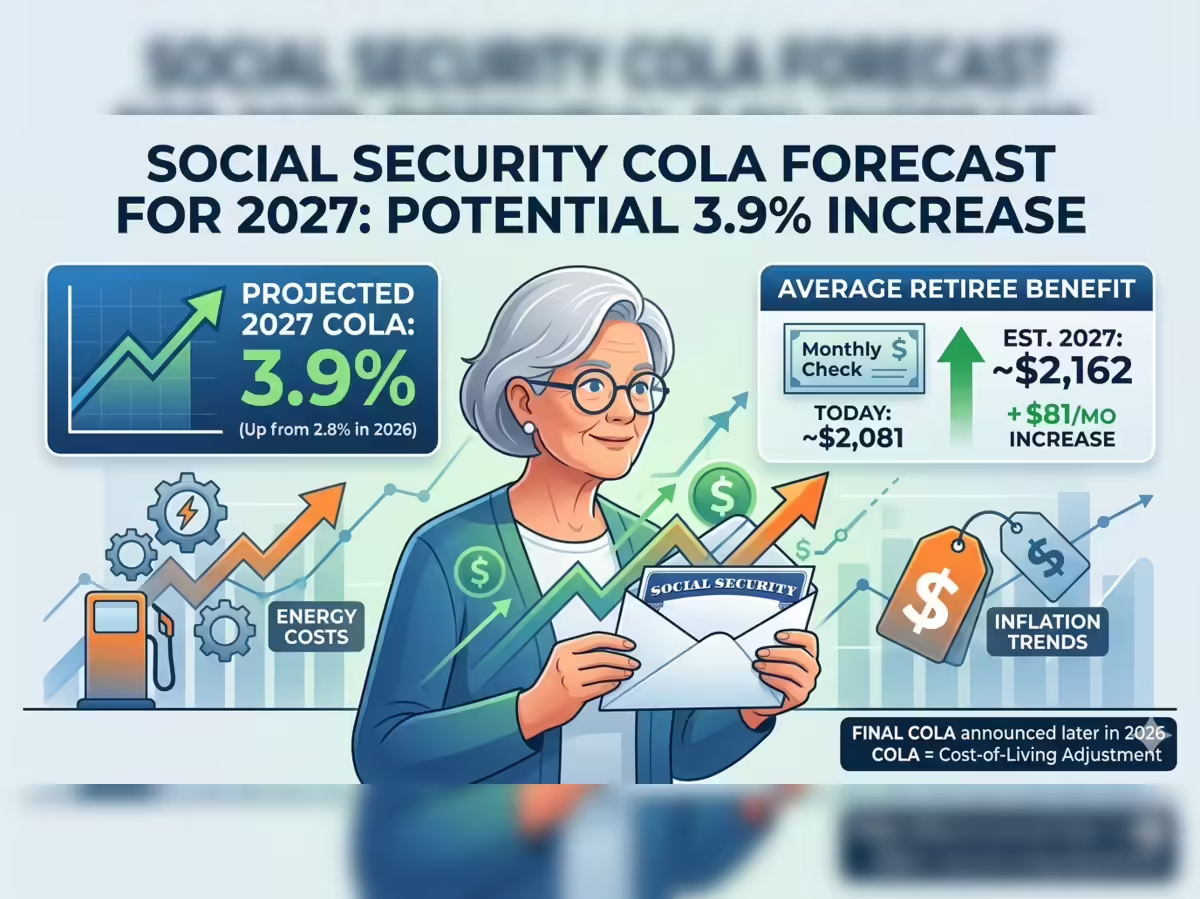
Several prominent organizations and independent analysts have weighed in on the anticipated 2027 Social Security COLA. The Senior Citizens League (TSCL), a nonprofit dedicated to advocating for seniors, predicts a 3.8% COLA for 2027. This projection is notably higher than the 2.8% COLA implemented for 2026, signaling a more robust adjustment to counter rising prices. Similarly, the American Association of Retired Persons (AARP) analysis forecasts a 3.6% cost-of-living adjustment for benefits next year.
Independent analyst Mary Johnson initially projected a 4.7% COLA for 2027. However, following the release of June's Consumer Price Index for Urban Wage Earners and Clerical Workers (CPI-W) data, she revised her forecast downward to 3.7%. This adjustment underscores the dynamic nature of these predictions, which are closely tied to evolving inflation data. The range of these projections, from 3.6% to 3.8%, suggests a consensus around a more substantial increase than the previous year.
What do these percentages mean in practical terms for beneficiaries? A 3.8% increase, as projected by TSCL, would translate to an average benefit rise of approximately $77 per month, moving from an average of $2,026 to $2,103. Another estimate suggests an increase of $73.62 from an average of $1,937. These figures, while seemingly modest on a monthly basis, accumulate significantly over a year and are crucial for individuals relying heavily on Social Security benefits for their income. It is important to remember that the official cost-of-living adjustment for Social Security recipients will not be formally announced until mid-October, when all necessary inflation data has been compiled.
02The Mechanics of COLA Calculation and Influencing Factors
The Social Security COLA is not an arbitrary figure; it is meticulously calculated based on specific economic indicators to ensure benefits reflect changes in the cost of living. Understanding this calculation process is key to appreciating the projections and their implications for the future.
The primary driver for COLA calculations is inflation, specifically measured by the Consumer Price Index (CPI). The Bureau of Labor Statistics' Consumer Price Index for Urban Wage Earners and Clerical Workers (CPI-W) is the index predominantly used for this purpose. The COLA is determined by comparing the average CPI-W for the third quarter of the current year (July, August, and September) to the average for the third quarter of the last year in which a COLA was payable. The percentage increase, if any, between these two periods becomes the COLA for the following year. This methodology ensures that the adjustment directly responds to recent inflationary trends.
Organizations like The Senior Citizens League (TSCL) play a significant role in providing monthly COLA projections by analyzing the latest CPI data as it becomes available. These projections offer valuable insights ahead of the official announcement, allowing individuals and financial planners to anticipate potential changes. For instance, the 2027 COLA estimates, such as the 3.8% prediction, are based on May CPI data, while other forecasts like the revised 3.7% from Mary Johnson incorporate data through June.
Beyond the macroeconomic factors of inflation, the amount of Social Security benefit payments an individual receives varies greatly based on personal circumstances. The formula for calculating individual benefits depends on a range of factors, including: lifetime earnings, the number of working years, marital status, and the age at which one begins collecting benefits. These individual factors mean that while the COLA percentage is universal, its monetary impact differs for each recipient. Therefore, a projected 3.8% increase will result in different dollar amounts for different beneficiaries, underscoring the personalized nature of Social Security planning.
03Navigating the Dual Realities: Higher Projections Amidst Future Adjustments
The outlook for the 2027 Social Security COLA presents a nuanced picture, characterized by both positive news regarding potential increases and critical provisions that could temper future adjustments. This dual reality necessitates a comprehensive understanding for effective financial planning.
On the one hand, the consensus among various forecasts points to a significantly higher 2027 Social Security COLA compared to the previous year. With projections ranging from 3.6% to 3.8%, this represents a notable increase over the 2.8% COLA for 2026. This higher adjustment is largely driven by persistent inflationary pressures, aiming to provide beneficiaries with greater purchasing power to offset rising costs of goods and services. For many retirees who depend on Social Security for a substantial portion of their income, a more generous COLA is certainly welcome news, offering a measure of relief in an environment of elevated expenses. The potential for an average benefit increase of $73.62 to $77 per month, while not fully bridging the gap with the average senior cost of living, provides a crucial buffer.
However, this positive outlook is tempered by a significant future provision. According to information from the Social Security Administration, starting December 2027, there is a proposed reduction in the annual COLA by 0.5 percentage point. This provision, which has been under consideration since at least 2005, introduces a long-term challenge to the efficacy of future cost-of-living adjustments. While the immediate 2027 COLA might be higher, this planned reduction indicates a structural change that could impact beneficiaries in subsequent years, potentially diminishing the protective effect of COLA against inflation over time.
This future adjustment is often discussed in the broader context of the fiscal health of Social Security. The Social Security Administration's 2026 Trustees Report has indicated that the federal retirement safety net is less than seven years away from fiscal depletion. Specifically, the Old-Age and Survivors Insurance (OASI) trust fund is projected to completely exhaust its accumulated reserves in the fourth quarter of 2032. Such projections highlight the ongoing need for policy adjustments, of which the COLA reduction provision is an example, to ensure the long-term solvency of the system. Therefore, while the 2027 COLA offers short-term relief, beneficiaries and planners must remain cognizant of these larger structural and fiscal challenges that will continue to shape the future of Social Security benefits.
04The AI Office Perspective: Data-Driven Planning and Human-AI Collaboration
In the modern enterprise, particularly within the dynamic environment of an AI office, navigating complex financial forecasts like the 2027 Social Security COLA becomes a prime example of human-AI collaboration. Platforms such as Nonilion are designed to empower organizations to leverage AI agents for strategic financial planning, ensuring that both individuals and the broader workforce are prepared for economic shifts.
AI agents within a Nonilion-powered workspace can play a pivotal role in tracking and analyzing the granular details of economic indicators. They can continuously monitor real-time inflation data, such as the Consumer Price Index (CPI) and its various components, to provide up-to-the-minute insights into COLA projections. This level of continuous data surveillance frees human financial analysts from manual data gathering, allowing them to focus on higher-level strategic interpretation and scenario planning. For instance, an AI agent could ingest reports from TSCL, AARP, and independent analysts, cross-referencing their projections against raw CPI data to identify trends and potential discrepancies, flagging significant changes like Mary Johnson's revised forecast from 4.7% to 3.7% following new CPI-W readings.
Furthermore, AI agents excel at modeling the impact of different COLA scenarios on long-term financial plans. They can simulate how a 3.6%, 3.7%, or 3.8% COLA might
05Why This Trend Matters for Nonilion
This trend matters to Nonilion because it points to a bigger change: teams are moving from simple calls toward persistent, AI-supported collaboration spaces. Nonilion can bridge live presence, meeting context, avatars, and follow-up work so the trend becomes a usable workflow instead of a headline.
06Shareable Extracts
The trend is not just "Decoding the 2027 Social Security COLA: Strategic Insights for a Future-Forward Workforce" - it is a signal that team coordination is becoming the next competitive edge.
Hot take: the teams that win from this shift will not be the ones with more meetings; they will be the ones with clearer shared context after every meeting.
If decoding the 2027 social security cola: strategic insights for a future-forward workforce keeps moving this fast, remote teams need a workspace where conversation, presence, and follow-up stay connected.
As we look towards 2027, early projections for the Social Security COLA are beginning to emerge, offering a glimpse into how future benefits might adapt to inflation.
Understanding these forecasts is not merely an exercise in financial prediction; it's a strategic imperative for individuals, financial advisors, and organizations alike.
07Social Hooks
Everyone is talking about Decoding the 2027 Social Security COLA: Strategic Insights for a Future-Forward Workforce. The overlooked part is what happens to team workflows after the headline fades.
The uncomfortable question behind Decoding the 2027 Social Security COLA: Strategic Insights for a Future-Forward Workforce: are teams adapting their collaboration systems fast enough?
This is not a meeting trend. It is a coordination trend, and products like Nonilion sit right in the middle of that shift.